Category: io

  • On Humanizing the Process of Tech Recruitment

    According to Korn Ferry study, the global human talent shortage will increase to around 85 million by 2030. This highlights the severe competition for talent and the need to improve candidate experience. After all, providing a good candidate experience goes hand in hand with creating a great employer brand. Companies must evaluate their recruitment procedures to satisfy the needs of the applicants. In our humble opinion, a positive candidate experience can be derived from using: 

    • A Consistent Point of Contact:  

    Interviews can be a confusing and stressful experience. Having the same person guiding the applicant through the entirety of the hiring process will certainly improve candidate comfort and engagement. 

    • Proactive Onboarding:  

    The first days are usually very exciting and disorienting for the employees. Orientations and peer support programs can provide role clarity and social integration desperately desired by the new hires. 

    • Informal interviews:  

    Interviewing people in a more casual setting or over coffee chats can help remove the applicant’s anxiety and stress. 

    • Effective communication:  

    Often recruiters fail to fill the vacancies due to ineffective communication. Employers need to share the complete outline of the hiring process as well as address any queries related to the job description. Prompt responses at each stage will make candidates feel more valued. 

    • Constructive feedback:  

    Many applicants complain about never hearing back from the recruiters. By providing feedback, companies can avoid losing out on unsuccessful candidates who might be a good fit for a different vacancy in the future. The situation could also be improved if only the recruiter pays more heed to manage candidates in a more meaningful environment – i.e. by sending them constructive feedback that contains a list of the applicant’s shortcomings, strengths, and useful information/courses.   

    A lot of times, reasons like technical skills gap became an excuse to shrug off candidates. However, by following these steps, there is a possibility the gap between the recruiter and the candidate be filled, enriched with a more meaningful relationship. 

  • Pakistan among the top countries in South Asia for Software Outsourcing

    Pakistan among the top countries in South Asia for Software Outsourcing

    Photo by Pexels on Pixabay

    Software engineering is a rapidly growing field, with a wide range of opportunities for qualified professionals. As the demand for software engineers continues to grow, companies around the world are looking for ways to maximize their software development teams and gain access to the best talent.  

    Outsourcing software development to South Asia is quickly becoming a popular option for businesses looking to increase their efficiency and lower their costs. In this guide, we will explore how and why Pakistan is becoming a top choice for software outsourcing in South Asia and the benefits of outsourcing software development in this region.

    Introduction to Software Outsourcing

    Software outsourcing is the process of hiring a third-party contractor or agency to develop or maintain software applications or systems. This can be done either remotely or on-site, depending on the company’s needs and preferences.

    Software outsourcing is a cost-effective way for businesses to access the latest technology, without having to invest in in-house development or maintenance. It also allows companies to quickly scale up their software development teams, without having to hire and train additional staff.

    Understanding Nearshore vs Offshore Outsourcing

    When it comes to outsourcing software development, there are two main options: nearshore and offshore.  

    Nearshore outsourcing is when a company outsources to a nearby country, often within the same region or even the same time zone. This can be beneficial for companies who want to maintain close contact with their software development team, as well as reduce any language/cultural barriers.

    Offshore outsourcing is when a company outsources to a distant country, often thousands of miles away. This proves to be perfect for companies who are looking to reduce costs, as labor costs in other countries tend to be significantly lower than in their own.  

    However, there can be some communication barriers and timezone differences, as well as cultural and language differences, that can make offshore outsourcing more challenging.  

    How can companies benefit from outsourcing their software development?

    Outsourcing software development to South Asia can be beneficial for a number of reasons.  

    • Reduces cost
    • Improves quality
    • Conserves capital
    • Fosters innovation
    • Saves valuable time
    • Increases speed to usage
    • Helps focus on core operations

    Overview of the South Asian Software Development Market

    The South Asian software development market is growing rapidly, with a wide range of opportunities for qualified professionals. This is due to a number of factors, including the availability of highly skilled software engineers, the low cost of labor, and significant time-overlap.

    The subcontinent is the largest software development market in South Asia, and is home to some of the world’s best software engineers and developers. Countries in the region, such as, Pakistan, Vietnam and the Philippines, are becoming popular destinations for software outsourcing.

    Why Pakistan is the ideal place to outsource software development in 2023.

    When it comes to outsourcing software development, one of the main considerations is the time zone. Different countries have varied time zones, which can make communication and collaboration a challenge.

    Pakistan is quickly rising the ranks for IT solution outsourcing for its quality of work and availability of dedicated teams. While the service is being outsourced, companies provide overlap timings as per international clients, varying from off-shore solutions to nearshore timings and even full time overlap.

    Many countries in South Asia, including Pakistan also offer flexible working hours. This proves to be a viable option for companies who need to access their software development team at specific times or during different time zones. Fortunately, most companies situated in Pakistan provide significant time overlap with many allowing round-the-clock availability for outsourced work.

    Moreover, about 300+ companies which includes several Global enterprises like Bentley®, Ciklum, IBM, Mentor Graphics®, S&P Global, Symantec™, Teradata®, and VMware® have established research and development centers, BPO support service centers and global consulting service centers in Pakistan.  

    Pakistan is also ranked 5th most financially attractive location in the world for offshore services, according to A.T. Kearney’ s Global Services Location Index 2019.

    Cost Savings

    The major benefit of outsourcing software development to South Asia is cost savings. Labor costs in South Asia, specifically Pakistan, are significantly lower than in many other countries. This can be beneficial for companies who are looking for budget-friendly software development, as they can access the same quality of talent for a fraction of the cost.

    The average cost of a software engineer per hour is $18 in Pakistan, making it one of the most affordable countries to outsource software development in South Asia. Not to mention, many countries in South Asia offer attractive tax incentives for companies who are looking to outsource IT solutions.

    Pakistan’s IT Industry growth has been augmented by the fact that costs remain low for it due to a plethora of factors such as low labour costs and strong government incentives.

    Fun fact: The average annual cost of a software engineer in Pakistan is one-fifth of the cost in USA and Europe.

    Quality Assurance

    Approximately 25,000 IT graduates enter Pakistan’s workforce each year, thus providing the Pakistani lT industry with the much-needed workforce. The area is home to some of the world’s best software engineers and developers. By outsourcing their software development, companies can access a wide range of highly skilled professionals.

    With more than 150 ISO quality standards qualified companies businesses outsourcing their IT solutions to Pakistan can ensure that their projects are completed to the highest standards.

    Access to Talent: Pakistan is one of the leading countries from where students enter the world’s most prestigious universities in large numbers. Pakistanis also rank high on intelligence scales.

    Seamless Cultural Integration:

    Most of the IT professionals, IT executives and company founders in countries like Pakistan have graduated or lived in the West. Finding a skilled workforce in Pakistan in the technology field does not present a problem for foreign investors and there are no cultural barriers to overcome as Pakistani professionals are used to interacting with clients based in developed countries.

    Conclusion

    Software engineering is a rapidly growing field, with a wide range of opportunities for qualified professionals. As the demand for software engineers continues to grow, companies around the world are looking for ways to maximize their software development teams and gain access to the best talent. Outsourcing software development to South Asian countries is quickly becoming a popular option for businesses owing to the many incentives they offer.

    If you’re looking to outsource software development, Pakistan is a great option to consider. With its attractive labor costs, nearshore hours or full time overlap, and access to some of the world’s best software engineers, it is quickly becoming the go-to destination for software outsourcing.

  • Press Release: Integriti Group Rebrands

    On 17 Oct 2022, we are happy to announce to you the launch of the new Integriti logo and website as part of the ongoing evolution of our company’s brand.

    The main image of Integriti Group unveils a brand new look blog post

    Following the breakout growth of our digital marketing and software development services over the past year, our team has been busy updating our visual identity to reflect our new capabilities and the vision of engineering growth for our clients.

    We believe that in today’s globally interconnected world and with the rise of digital transformation, enterprises need smart technology solutions to achieve operational efficiency, business growth, and competitive disruption. Not only do they require flexible solutions but also visionary partners like Integriti that can speak their language.

    Today, we’re proud to be a trusted partner of leading organizations and to have delivered successful outcomes in a variety of projects ranging from designing an enterprise knowledge-sharing system to developing a large e-commerce platform. Complementing our industry-leading software development expertise, we provide UX/UI design and content marketing through our high-performing and results-driven marketing team, also known as “Magnetic Marketing”.

    With Integriti embarking on a new journey and providing more exciting solutions, we believe this is the right time to create a new brand look that allows us to tell our multi-service story better. We also want our brand to be reflective of our promise of seamless communication, real collaboration, and cultural alignment with our clients.

    The New Integriti Has Arrived.

    Our challenge was to honor Integriti’s identity while making the new branding reflective of the company’s growth. We have retained the “i” in Integriti from the older logo and have created a more vibrant, bold, and modern design. Without going far from the old identity, our new logo successfully communicates our growth-oriented spirit and our varied range of services.

    Brand Elements

    “i” for Integriti

    Our brand mark, the “i” in Integriti represents order, trust, and stability which is why it is the center of attention in the logo design. Itis reflective of not only the integrity with which we serve our clients but also embodies our penchant for innovation.

    Color Palette and Gradient

    A gradient represents a direction of maximum change. We have used colour gradient comprising of blue and purple to reflect our two major services of Software development and Digital marketing respectively.

    Font Changes

    We wanted our font choice to be more dynamic, bold, and modern. Without straining too far away from the old identity, we have selected a more symmetrical Sans Serif font to blend in with our overall branding.

    Revamping our website

    We have also revamped our website according to the new brand identity and are continuously working to improve the user experience. The new site offers informative content on our services in a more clean and organized layout to ensure a positive user journey. The new brand identity and website are designed to further elevate Integriti as we continue to provide leading-edge digital solutions for our current and upcoming customers.

  • Secrets of performance-oriented frontend development

    When a web page takes longer than three seconds to load, 40% of visitors leave, increasing the bounce rate.  

    Similarly, a slow mobile app would also have poor performance and irritate consumers. After a few tries, the customer will remove your application and download a more user-friendly one.

    The ease of use and user-friendliness of your specific digital solution has a direct impact on the performance of the app. If compromised, it degrades the user experience and lessens the likelihood that users will engage frequently or stay connected to the app or website over time.

    On the other hand, developing a web or mobile app with front-end performance in mind increases the chance that your product will succeed. As a result, your priority should be to create an app or website that loads quickly, is SEO-friendly, performs well, and is well-designed.

    Here are a few secrets that can help you build up your performance-oriented front-end development.

    Optimize Images & Use WebP 

    Images are a crucial component of web pages. Considering they increase user engagement, 93.7% of websites on the internet employ at least one image file format.

    The drawback of using images is that, unless they are optimized, they have a negative impact on the front-end loading time. However, there are various approaches to optimizing images:

    Use AVIF or WebP

    Compared to previous formats like JPEG and PNG, using modern image formats like WebP and AVIF shows better performance. When compared to JPEG and PNG, WebP is between 25% and 35% smaller. AVIF is 20% and 50% smaller than WebP and JPEG, respectively.

    The browser support is the drawback, though. WebP acquired browser support only recently, so older versions may not support it. In contrast, Chrome and Opera are the only browsers that support AVIF. As a result, you must utilize the <picture> element in native HTML with fallback support.

    Serve images of the right dimensions.

    Using responsive images is another approach to speed up a website’s performance and cut down on image delivery time. Mobile and tablet devices account for more than 50% of all traffic. The frontend loading time could be further reduced by scaling the image to popular device dimensions and serving it using a srcset.

    There are numerous other methods you can use to speed up the frontend loading time through image optimization in addition to picking the right format and dimensions. Additional recommended best practices are:

    • Use of progressive JPEGs.
    • Use of HTTP/2 instead of HTTP/1.1.
    • Use of image sets.
    • Image Compression
    • Serve smaller images to users on slow connections.

    Compress Files & Use CDNs 

    Building a lightweight front end for your web or mobile solution is made much easier with the use of content delivery networks, or CDNs. These web directories have a successful global network. Your app will load more quickly if you use files hosted on CDNs since you can use the cached versions of the files from the closest servers. It enables you to quickly serve more users while preventing bottlenecks.

    Compressing the files to be used comes next after using common files from CDNs. Every file, including documents, images (JPEG, PNG), videos, audio clips, and presentations, can be compressed to enhance the functionality of your application. There are many compression tools available on the market that might be deployed for this.

    Once you’ve completed these two steps, your website or application will be much more responsive to consumer inquiries.

    Bundle & Minify Assets 

    Two different performance improvements you may use in a web app are bundling and minification. By minimizing the amount of the requested static assets and decreasing the number of server requests, bundling and minification combined enhance performance.

    Multiple files are combined into one file by bundling. The quantity of server requests required to render an online asset, such as a web page, is decreased via bundling. Numerous unique bundles made expressly for CSS, JavaScript, etc. are possible. Having fewer files means that the browser will make fewer HTTP requests to the server or to the service that hosts your application. As a result, first-page performance is enhanced.

    Code that has undergone minification has unnecessary characters removed without affecting functionality. As a result, the size of the requested assets is significantly reduced (such as CSS, images, and JavaScript files). One of the most frequent side effects of minification is the reduction of variable names to one character, as well as the removal of comments and extraneous whitespace.

    Bundling and minification mainly speed up the first page request load time. After a web page has been requested, the web browser caches the static assets (JavaScript, CSS, and images). Therefore, bundling and minification don’t enhance performance when the same page, or pages, on the same site, are requested with the same assets. If bundling and minification aren’t used and the expires header isn’t set correctly on the assets, then the browser’s freshness heuristics mark the assets stale after some days. The browser also requires a validation request for each asset. Bundling and minification in this situation increase performance even after the initial page request.

    Use Caching and prefetching 

    Pre-fetching and caching are two essential tools for front-end web performance. Pre-fetching involves pre-loading resources such as images, scripts, and stylesheets so that they can be delivered to the user more quickly. Caching, on the other hand, involves storing assets on the user’s device so that they don’t have to be requested from the server every time the user visits the site.  

    Both of these techniques have a huge impact on website performance and user experience. By pre-loading resources and caching assets, sites can load faster and be more responsive, leading to improved performance and better user experience. Additionally, pre-fetching and caching can reduce the burden on the server, which can help to keep costs down and make sites more resilient.  

    So if you want to improve your site’s performance and user experience, be sure to take advantage of pre-fetching and caching.

    Reduce The Number Of Server Calls.

    Generally speaking, the more requests your front end sends to the server, the longer it takes to load. This is due to the fact that sending any request to the server demands full communication before the page can be rendered. There are several approaches you may take to cut down on the number of server requests required to load the website.

    One of the simplest ways to cut down on server calls is to use CSS Sprites. Sprite loads a single image file combined using a collection of images rather than ten separate images to the site. The background image and background-position CSS properties can be used to display the desired image segment. By doing this, you’re minimizing the number of server requests necessary.

    Reducing third-party plugins is also important as they make up a large number of external requests and cutting down on them will boost your application’s loading speed. Preventing broken links to files that don’t exist can also help.

    You might also consider server-side rendering to accelerate the application’s initial load time.

    Making the initial move is never easy. The future, however, belongs to those who aren’t scared to innovate and redefine conventional approaches. You can ensure that your website loads quickly and offers a positive user experience by using these web performance optimization approaches. Just be sure to keep everything simple, smart, and seamless. And keep in mind that you only have 15 seconds to make an impact!

    First impressions of apps and websites are based on their user interface (UI) and front end. The ease of use, seamless navigation, and fast loading are just a few of the elements that determine whether a user will use your digital product again. Therefore, it’s crucial to consider a web solution’s performance efficiency, whether it’s an App or an e-commerce website. You will be able to do so by using the advice we’ve provided above.

    Need help improving your front-end performance? Explore how our software engineering models can help your business here.

  • Serverless Architecture

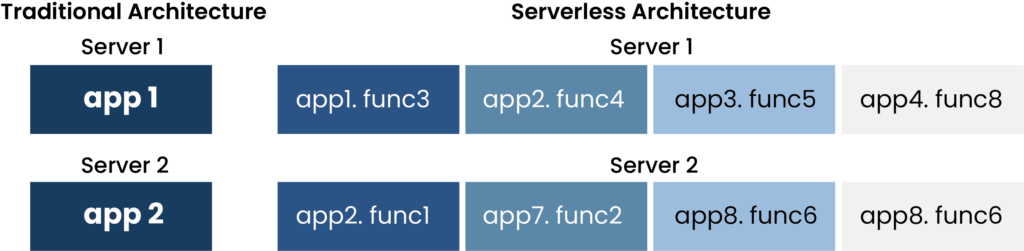
    Serverless computing, also referred to as simply Serverless, is a famed topic of the software architecture world. The biggest cloud-providing platforms like Amazon, Google and Microsoft are continuing to invest heavily and research on this type of architecture. Serverless is a cloud computing code execution model where a certain cloud provider takes over responsibility for servers running along with computing resources management. To put it in a simple view, there are no physical or virtual servers to manage, because they are automatically deployed in the cloud by the third-party vendors. Some of the famous serverless providers are AWS Lambda, GCP Functions and Azure Functions.

    The main difference between the traditional and serverless architecture can be schematically seen in diagram 1.

    A diagram which shows the Traditional vs serverless architecture.
    Diagram 1: Traditional Vs. Serverless

    Components of the serverless application are:

    Functions

    Functions are what imply business and application logic. They execute code for certain actions. There can be multiple functions working as a composite function. Sometimes they may be triggered or self-initiated when a condition is met. This process is hidden from the user. The user creates a program code, specifies needed dependencies and uploads it. The provider then provides the computing environment.

    Backends

    This unit allows the development to shift backend regular functions from data storage to the cloud, managing latency of the architecture and dependencies deepening. It also aids with functionalities like Simple Notification Service (SNS), Simple Queue Service (SQS), kinesis for streaming data, data warehouse queries, batch data cloud dataflow and event grids.  

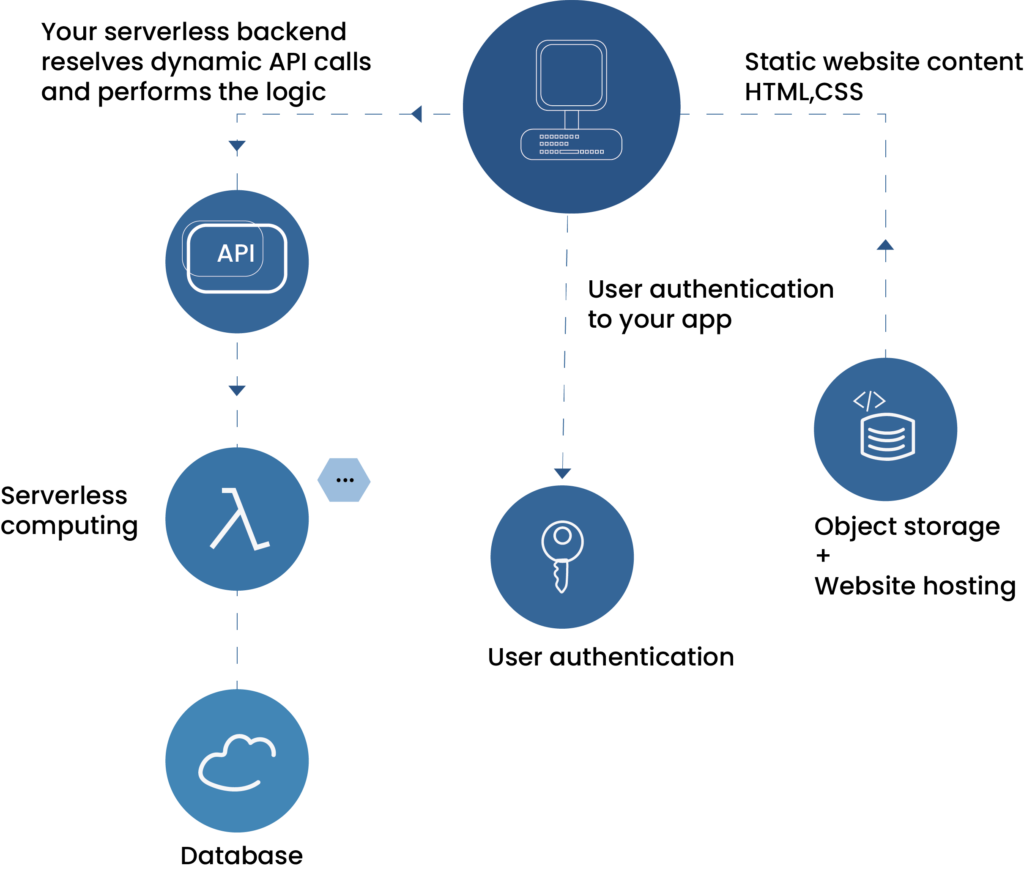
    Here is how a serverless setup looks like.

    Image shows serverless states
    Diagram 2: Serverless State

    When we talk about Serverless, it is primarily defined by two different but overlapping areas: “Backend as a Service” (BaaS) and “Function as a Service” (FaaS). BaaS and FaaS are related in their operational attributes and are frequently used together. Let’s find out what each of these scopes encompasses.

    BaaS

    This term is used to describe applications that significantly or fully incorporate third-party, cloud hosted applications and services to manage server-side logic and state. These are typically rich client applications like single page web apps or mobile apps that use the vast ecosystem of cloud accessible databases (e.g., Firebase), authentication services (AWS Cognito) and so on.

    FaaS

    This term is used to describe applications where server-side logic is written by developer but unlike mainstream architectures, its run-in stateless computer containers are event-triggered, ephemeral and managed by a third party. Containers specify OS and software configurations. Regarding uptime, the container keeps working until the current job is executed and destroyed. It can host any microservice and app and there are no timeout restrictions.

    Faas, replaces the click-processing physical server with something that does not need a provisional server nor a related app. The only code that needs to change when moving to FaaS is the main method, also called startup code. Handlers which manage message listener interfaces are also changed in the method signature.

    Deployment is very different from traditional systems. The code is uploaded to the FaaS provider and then the provider instantiates VM’s and manager process. Horizontal scaling is completely automatic, elastic and managed by the provider. If the system needs to process a hundred requests in parallel, computer containers come into play. They execute the functions and are created and destroyed purely driven by runtime need. Functions in FaaS are typically triggered by event types defined by the provider. Such event types include S3 (file/object) updates and Kinesis. They may also be triggered as a response to inbound HTTP requests via API gateway. However, this is an uncommon use of configuration from within the same cloud environment.

    When working in an instance-bound state or a machine state, there may be some restrictions posing to FaaS. Like data that is stored in variables or local disk. Such storage is available but there is no guarantee that such a state persists across multiple invocations and more strongly there should be no assumption made that state from one invocation of a function will be available to another invocation of the same function. This is the reason why FaaS are often described as stateless. But this may not a correct techical assessment. Rather it is appropriate to say that any state of a FaaS function that is required to be persistent needs to be externalized outside of the FaaS function instance. Any function will typically make use of a database, a cross app cache like Redis or a network file/object store to store state across requests or to provide further input necessary to handle a request.  

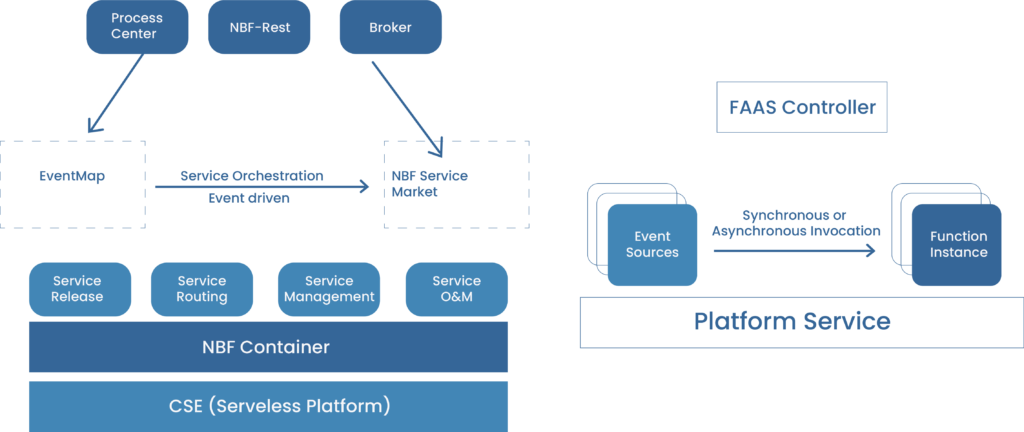
    New-retail business framework (NBF) is an open framework developed by the supply chain infrastructure technology team for new retail services. A serverless system like FaaS helps NBF achieve industry standard practices, load balancing and long-term sustainability. Diagram 3 shows how NBF works in conjunction with FaaS.

    Image about NBF-FaaS Architecture
    Diagram 3: NBF-FaaS Architecture

    Event Sources Function is an event driven set. Function Instances provide functions or microservices. The FaaS Controller manages function control services such as API Gateway or Backend for Front (BFF). Platform Service Functions relay on platform services such as privilege management API’s and OSS. Cloud Service Engine (CSE) provides dynamic scaling capabilities which rapidly adapt to different resources needs during on and off-peak hours. CSE optimizes container cold, hot start performance and serverless O&M tools such as logging, monitoring and link tracking. NBF containers use Open Service Gateway Initiative (OSGI) architecture and provide complete bundle lifecycle management, including load, start, unmount and delete as well as isolation and communication. The whole platform capabilities result in services release which allows for quick release of a function or to bundle as a service, service routing which includes polymorphism, degradation and moke routing, service management with service vision control and service start/stop and lastly the service O&M for serverless services, hybrid deployment, phased release, disaster recovery.

    Lastly the important concept to grasp is bundle communication. Bundles are able to utilize container capabilities such as Spring context hosting and AOP by using the import mechanism provided by containers. For example:

                  org.springframework       org.apache.commons.logging         org.aopalliance       org.aspectj    


    The NBF containers create an independent sandbox for each bundle which ensures code level bundle isolation from time of loading thus preventing class and resource conflicts among bundles. They manage bundle context globally and provide plug-in hosting. This sums up how FaaS works and conjoins.

  • Shopify Plus: Is it Worth the Investment for Large-scale E-commerce?

    Shopify Plus: Is it Worth the Investment for Large-scale E-commerce?

    Picture background
    Shopify Plus: Is itWorth the Investment for Large-scale E-commerce?

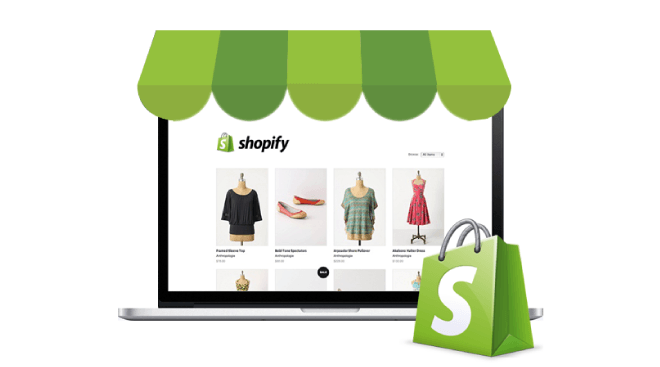
    In the world ofe-commerce, where competition is fierce and customer expectations are everevolving, choosing the right platform for your online store is a criticaldecision. For large-scale e-commerce businesses, scalability, flexibility, andperformance are paramount. Shopify Plus, the enterprise-level version of thepopular Shopify platform, has emerged as a compelling choice for businesseslooking to take their operations to the next level.

    But is it worth theinvestment? Let’s delve into the key considerations to help you determinewhether Shopify Plus is the right fit for your large-scale e-commerce venture.


    UnderstandingShopify Plus

    Before we assess itsworth, let’s first understand what Shopify Plus brings to the table:

    • Scalability: Shopify Plus is designed to handle high-volumesales and traffic, making it suitable for large e-commerce stores experiencingrapid growth.
    • Customization: It offers extensive customization options,including access to the platform’s source code, allowing businesses to tailortheir online stores to their unique needs.
    • RobustInfrastructure: Shopify Plusincludes features like unlimited bandwidth, automated backups, andenterprise-grade security, ensuring reliability and protection of your onlineassets.
    • DedicatedSupport: Users of Shopify Plusreceive dedicated support, which can be crucial for resolving issues promptlyand efficiently.
    • Multi-Channel Selling: With Shopify Plus, you can easily expand yourpresence across various sales channels, including social media andmarketplaces.

    Now, let’s dive intothe factors that can help you determine whether investing in Shopify Plus isjustified for your large-scale e-commerce business:

    • SalesVolume: Shopify Plus is mostcost-effective for businesses with significant sales volumes. If you’reprocessing a substantial number of transactions each month, the platform’sfixed pricing model can be advantageous.
    •  CustomizationNeeds: If your businessrequires extensive customization, Shopify Plus provides the flexibility tocreate a tailored online shopping experience. Evaluate the extent ofcustomization you need and whether it justifies the additional cost.
    • Performanceand Reliability: Consider yourcurrent and projected website traffic. If you’ve experienced website slowdownsor outages due to high traffic, Shopify Plus can provide the performance andreliability you need to prevent such issues.
    • GlobalExpansion: If your e-commercebusiness is expanding internationally, Shopify Plus offers multi-language andmulti-currency support, simplifying the process of reaching global markets.
    • DedicatedSupport: Assess the importanceof dedicated support. For large-scale operations, having a responsive supportteam can be invaluable in resolving technical issues and improving the overallcustomer experience.
    • TotalCost of Ownership: Calculatethe total cost of ownership, factoring in the platform’s subscription cost,development and customization expenses, and potential third-party app costs.Ensure that the benefits outweigh the investment.
    • CompetitiveAdvantage: Consider how ShopifyPlus can give you a competitive edge in your niche. Are the features itprovides essential for staying ahead of your competitors?

    Conclusion

    Shopify Plus isundoubtedly a powerful platform with a range of features tailored to meet theneeds of large-scale e-commerce businesses. However, whether it’s worth theinvestment depends on your specific circumstances and goals. Carefully evaluateyour sales volume, customization requirements, performance needs, and growthplans to determine if Shopify Plus aligns with your business strategy.

    In many cases, the benefitsof Shopify Plus, including scalability, customization, and dedicated support,can outweigh the costs, making it a sound investment for large-scale e-commerceventures committed to delivering exceptional online shopping experiences.Ultimately, the decision should be based on a thorough analysis of yourbusiness’s unique requirements and long-term objectives.

  • Should consumer electronics brands tweak content according to the social media platform?

    Cross-posting has been on the block ever since the internet exploded and the world got caught up in a whirlwind of digital marketing. With yearly new platforms introduced with the latest features, internet nomads naturally run towards them. 

    More social media apps mean more platforms for marketers to find and target their audience. But while we’ve established that a social presence on every platform ever is not an absolute necessity for most brands, and if it’s required, cross-posting can be truly lifesaving. 

    That said, the concern about altering content for each platform runs rampant among marketers. Depending on who you’d ask, some marketers will advise posting the content as is – with minor adjustments, and some would say to make major alterations. 

    But who to trust?

    By taking the examples of some of the biggest electronics brands in the social media marketing world, let’s answer the question. Should these companies tweak content according to the social media platform when trying to establish a multi-platform presence?

    VIVO Pakistan Facebook page
    Source: Vivo Facebook

    vivo Pakistan Instagram page
    Source: Vivo Instagram

    The first step would be to carry out a social media SWOT analysis

    Businesses can evaluate how their current marketing practices are performing based on the SWOT analysis method. Most companies are familiar with running paid ads and are therefore experienced with gauging conventional campaign success through metrics like CAC, (customer acquisition cost) ROI (return on investment) and CPC (cost per click). 

    A SWOT analysis, however, looks beyond it and identifies critical elements like faulty asset promotions, customer satisfaction and competitors pushing a business out of the market. 

    Having some insight into what your standing among customers on different platforms is, can give you a good idea about what content type and‌ narrative work best. 

    Check what resonates with the audience (trial and error at first)

    Once you have the results from the SWOT analysis and a clear picture of the content preferences of different audiences on different platforms, it would be best to tweak your content accordingly. 

    If you have been posting a lot of static content or informative posts on Instagram but not seeing engagement despite your content being top-notch, it would be better to alter the narrative slightly and turn the same copy into a reel. 

    Instagram’s algorithm prioritizes reels over images and, from a consumer’s point of view, watching a video is significantly easier than reading a post. Similarly, another approach could be assessing what your competitors are doing and checking the current marketing trends. 

    Taking inspiration from consumer electronics companies like Sony, you can create your cross-posting strategy accordingly. 

    Moulding content around the platform. 

    Some content forms are suitable for specific social media platforms. For example, short-form videos are perfect for TikTok and Instagram. And though cross-posting the same thing on all social fronts would be time-saving, it would make little sense to push reels on a text-based website like Twitter. 

    The key is to club similar platforms together. Facebook, Twitter and LinkedIn are mainly text and community based so cross-posting between these two with minimal variation could work.

    However, if the same thought or copy needs to be incorporated in a visual-first platform, we’d suggest changing the content type to perhaps a video or a carousel. 

    Striking the right tone

    Building up on customising content around the platform, electronics brands also need to gauge the tone of the website and then create content around it. 

    Instagram is the perfect hub for pulling back the curtain and showing a more humanistic side of a business. The tone of the platform is more fun, casual and vibrant and content with human faces takes the cake for engagement. Similarly with TikTok, given the laid-back and “authentic” approach the platform has towards content, tech brands can certainly repurpose media with minor changes between them.

    As for LinkedIn and Twitter, both are heavily reliant on text, but some semblance of graphics can be introduced to break the monotony of text. 

    Lastly, Facebook is the best of both worlds and can become the perfect tool to balance text and visuals. Pictures and videos thrive on the platform, but shouldn’t be as casual or laid-back as TikTok or Instagram. Text is suitable but not as formal as LinkedIn either.

    Now, let’s have a look at how Samsung, Panasonic and Toshiba have developed their social media presence on Facebook and Instagram.

    Samsung:

    Boasting a whopping 869k followers on Instagram, the content Samsung puts out is a comfortable balance of engaging and informative. Samsung optimally uses Instagram’s preference for reels and makes them a large chunk of the company’s content on IG.

    For Facebook, they have divided the page into two categories where Samsung Global focuses on the video format and the content itself is more polished and professional. Samsung Electronics is the second page that zeroes in on text-based content.

    However, the content on both platforms is different altogether, with little overlap, if any.

    Samsung Electronics Official Facebook page
    Source: Samsung Electronics Facebook

    Panasonic:

    Panasonic nails its Instagram content strategy by putting a tonne of employee faces on the feed. The visuals are engaging, and employee-centred and the text is light and digestible.

    For Facebook, the tech giant opts to portray a slightly more professional appearance with professionally made videos and more text-heavy informational content. 

    A picture of Panasonic Facebook page
    Source: Panasonic Facebook

    Toshiba:

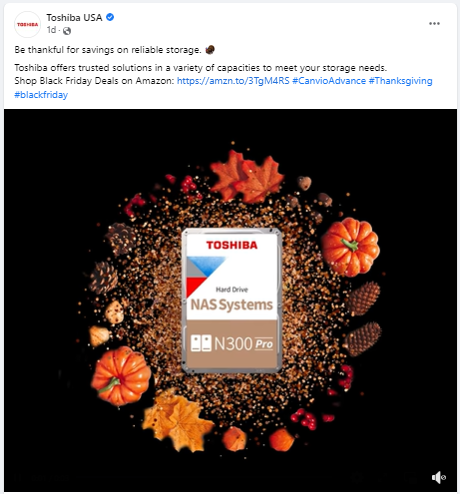
    The Japanese multinational conglomerate has a strong social media presence but cross-posts every piece of content. The copywriting hasn’t changed per se but only the CTA’s are. 

    One can attribute the brand’s marketing efforts to an equal blend of images and informative and accessible textual content that makes it perfect for both Meta platforms.

    A picture of Toshiba post on Instagram
    Source: Toshiba Instagram

    A picture of toshiba post on Instagram
    Source: Toshiba Facebook

    To sum up:

    Cross-posting is a great time saver, but to offer customers the best depiction of the business, tech brands should tweak content based on their audience’s behaviour on different platforms. 

    If they have the option to create fresh content for each website, that’s perfect! But if not, repurposing the same content but in different forms (text into explainer video etcetera), can help create and schedule a consistent image across platforms. 

  • Target audience: harnessing the power of knowing your market

    One of the very first things when venturing to start an online business – or even a physical one – is to have a clear idea of the people you’re going to be targeting. A target market strategy will effectively get the message to the right people.

    But first, let’s define what a target audience is.

    A target audience is a group of consumers who you want to reach with your targeted marketing efforts. Your ideal customer group can be characterised by multiple factors that can be as vague or as specific as you wish. 

    The characterisation can be done based on specific demographics and psychographics such as:

    •  Age
    • Gender
    • Area
    • Income
    • Interests 
    • Behaviours

    And more.

    Tip: To see optimum results we do advise narrowing your target audience down to the dot.

    These groups are the key influencers in the decision-making processes for marketing strategies. A target audience of a business decides how to appeal to them, where to spend the budget and what commodity to build next.

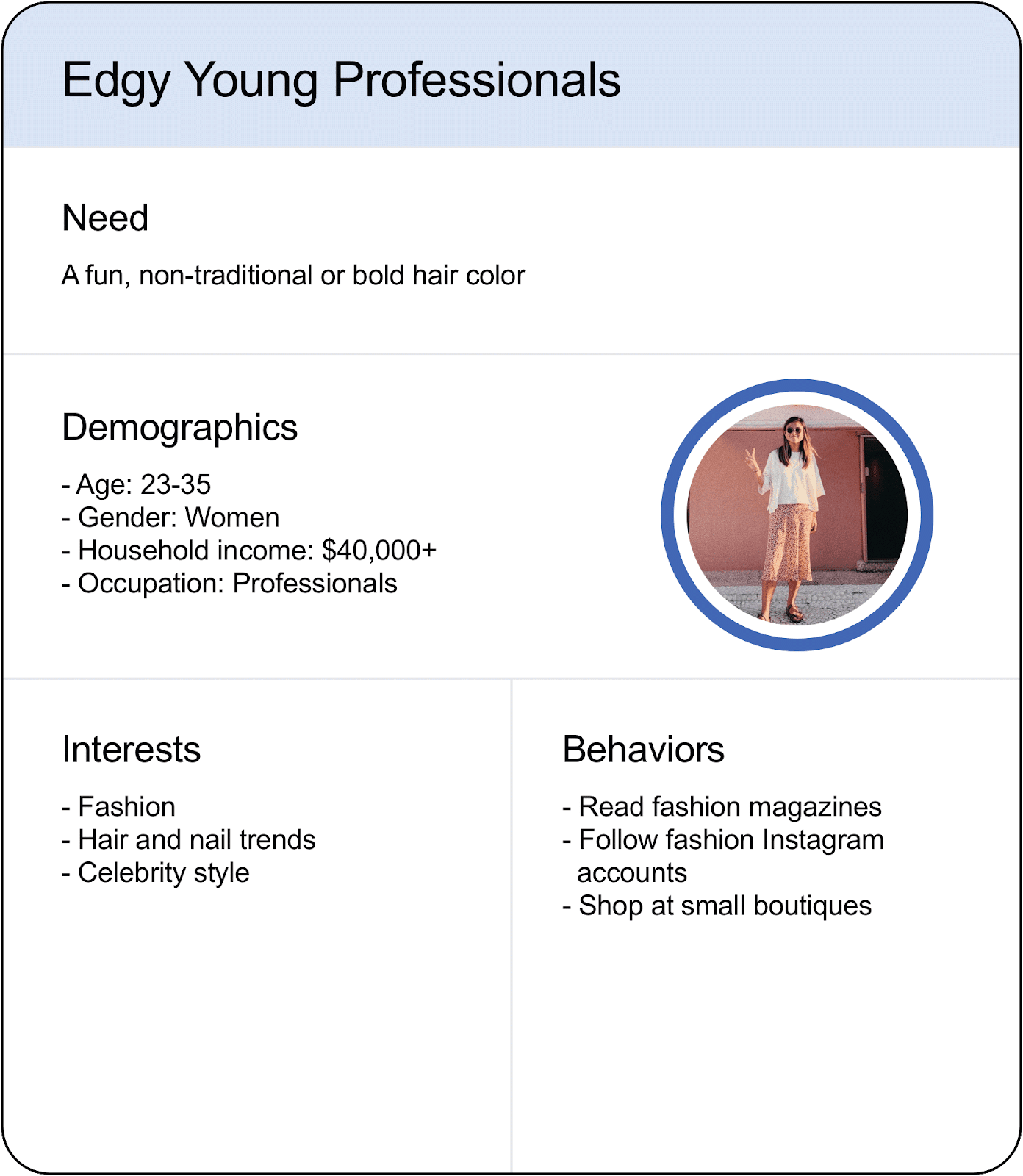
    Once your target audience is defined, you could also go a step further in defining your buyer personas. A buyer persona is the ideal target audience profile that a business wishes to target based on the data collected from the target audience. 

    Image Explaining why business needs to track the audiences.
    Image Source: Meta Blueprint

    The information helps businesses understand their audience and it’s purchasing behaviours. Targeting a specific audience will help in conveying your message to the right audience who will relate most to your message.

    To help you understand here’s an example.

    Let’s take a stationery item for students as an example. Given that the item is mainly for students, we have our first distinction. If the product is priced higher, the students would be divided into households with specific incomes. Not to mention, if it is targeted specifically to girls, the demographic would be further narrowed down even more.

    So now we have school-going girls belonging to a household with x-amount of monthly income. 

    This is a target audience for a product aimed at upper-class school-going girls. While the business may target boys, or adults even, it may not be the best choice because they would be least likely to purchase it.

    The people in your target audience could be anyone but what would tie them together is an interest in the product you offer. 

    Target market vs target audience? Which one should you work with?

    The terms target market and the audience may sound synonymous and they do refer to mainly the same thing. Still, businesses and marketers must know the difference. 

    Both terms revolve around dividing larger groups into sub-segments. However, target markets pertain to a larger group of consumers that the business targets and the target audience are a further breakdown of said group based on interests, buying history and demographics. 

    Safe to say, you can define your target market by first detecting your target audience. For example, if a target market is “fashion students aged 18-30” the target audience would be “fashion students living in New York City, aged 18-30”.

    Dividing your target audience.

    A business can have more than one type of audience. The two can be classified as:

    Image for Primary target Audience
    Image Source: Understand audiences

    • Primary target audience 

    A primary target audience is a group that will get most of a business’s attention as they are most likely to become valuable and loyal customers.

    Image for Secondary Target Audience
    Image Source: Target Audience

    • Secondary target audience

    The secondary target audience on the other hand is a group who may be interested in a product and have common characteristics with your primary target audience but there’s an improbability for them to become valuable customers. 

    This group may not directly include the ideal buyer persona but influencers of their decision-making process too. 

    Children are sometimes a part of the secondary target audience for products targeted towards parents. Also, having a defined secondary cluster of customers can help businesses shape their marketing. Mainly if a business sells more than one product, the overlapping interest between the two groups can appeal to the secondary audience rather than the primary.

    Capitalise on your market knowledge.

    Identifying your target audience can streamline a tonne of processes for a business. Which include but are not limited to

    1. Maximising resources and time

    Just as a vegan food business has its ideal clients so does a steakhouse. Defining the market that needs your services can help understand it and place the product and service accordingly.

    The research becomes the pillar on which the marketing of said business can stand. Casting the net wide and encompassing a broad array of consumer base may seem like the best approach initially but it can severely hamper growth and marketing efforts.

    It’s important to realise how a brand’s message may not resonate with everyone, thus focusing time and resources on a clearly outlined segment can be more rewarding and productive for an organisation.

    1. Does less engagement mean less ROI?

    Engagement being directly proportional to ROI is one of the most widespread social media marketing myths.

    Absolutely no. When a business makes the effort to successfully identify who its target audience is, a focused approach can maximise ROI significantly. For example, when targeting social media users a narrowed approach can bring better results when targeted with tailored content.

    Social media targeting is one of the most popular and rewarding approaches being implemented by businesses all around.

    1. Efficiency in processes – better rewards

    When a business finds the audience that is most likely to convert, creating content that addresses their challenges, concerns and apprehensions can help in tipping the scales.
    Rather than focusing on an audience that may engage with your efforts but isn’t willing to open their wallets, it is better to utilise resources and position your strategy to cater to those who will. 

    Conclusion:

    A single business of course has different types of audiences. We suggest identifying what stage of the buyer journey your customers are on and reaching out with relevant content. Similarly, another approach could be pushing content according to the sales-funnel stage prospective customers are at. 

    Consumer A might be looking for some help in deciding whereas consumer B may need to be educated from scratch.

  • INTEGRITI GROUP INC. RECEIVES 2022 BEST OF STAFFING TALENT AWARD FOR SERVICE EXCELLENCE

    Mississauga, ON (February 8, 2022)– Integriti Group Inc., leading software development and digital commerce service provider, announced today that they have won the Best of Staffing Talent Award for providing superior service to their candidates. Presented in partnership with presenting sponsor Indeed and gold sponsor Talent.com, ClearlyRated’s Best of Staffing® Award winners have proven to be industry leaders in service quality based entirely on ratings provided by their candidates. On average, job seekers who work with winning agencies are twice as likely to be completely satisfied with the services provided compared to those placed by non-winning agencies. Integriti Group Inc. received satisfaction scores of 9 or 10 out of 10 from 80% of their placed job candidates, significantly higher than the industry’s average of 40%.  

    “Finding and retaining quality tech talent has been a struggle in a post-pandemic world. Talent satisfaction has always been a priority for us as it allows us to provide our clients with top-notch augmented and dedicated teams for onshore, offshore, and nearshore development. We are proud to have been recognized by ClearlyRated for our commitment to candidate engagement and experience”. said Kamran Azam, Partner, Integriti Group. 

    “Winning this industry-recognized award for a second year is a testament to our team’s dedication to the candidate experience. We work with highly talented software professionals. At each stage of their journey our candidates feel fully valued and appreciated by everyone at Team Integriti.” said Omer Husain, Partner, Integriti Group. 

    “Winners of the 2022 Best of Staffing award have demonstrated their commitment to delivering exceptional service, even as Covid-19 has forced them to reimagine and rebuild their approach to business,” said ClearlyRated’s CEO and Founder, Eric Gregg. “These service leaders have kept the client, talent, and employee experience at the heart of their business strategy, and it’s my honor to celebrate and showcase the 2022 Best of Staffing winners alongside feedback from their actual clients on ClearlyRated.com!” 

    About Integriti Group Inc. 

    Integriti is an award-winning IT services provider based in Mississauga, Canada. It has been selected among the Top Custom Software Development Companies in Canada by Designrush. It blends extensive technological knowledge with real-world experience to provide companies with premium software development and digital commerce services which can bolster their growth. For more information on Integriti, visit https://integriti.io/about-us

    About ClearlyRated 

    Rooted in satisfaction research for professional service firms, ClearlyRated utilizes a Net Promoter® Score survey program to help professional service firms measure their service experience, build an online reputation, and differentiate on service quality. Learn more at https://www.clearlyrated.com/solutions/

    About Best of Staffing  
    ClearlyRated’s Best of Staffing® Award is the only award in the U.S. and Canada that recognizes staffing agencies that have proven superior service quality based entirely on ratings provided by their clients, placed talent, and internal employees. Award winners are showcased by city and area of expertise on ClearlyRated.com—an online business directory that helps buyers of professional services find service leaders and vet prospective firms with the help of validated client ratings and testimonials. 
     

  • Technical Skills Gap A forced Belief

    When it comes to technical recruitment, there are numerous ways to distinguish between a right and wrong candidate, just like there are ways for a candidate to scan the right job for themselves. As much as it seems theoretically simple, it really isn’t when one practically starts looking for a job or potential candidates, especially in the IT field. 

    One can truly understand this dilemma through the example of the U.S. (2014): 4.7 million jobs advertised while 9.7 million candidates were looking for jobs, which made more than 2 for every job advertised, YET employers complained about failing to fill the vacancies.

    This helps us to wade deeper into the cause of the problem.

    Companies that couldn’t find the “right fit” were the ones to use the “skills gap” as the cause of this dilemma – especially those concerned with IT recruitment. What’s even more interesting is the fact that none of these companies provided a real agreement about what skills were unavailable. 

    Now we can further identify the real culprits behind the massacre of the “right candidates” per see

    Gap existing in competitive incentives

    If you are not willing to pay for the skills you require from a resource, there is a very slim possibility of finding the “right candidate” who could ‘hit the ground running’. Knowing competitive salaries for specific technical skillsets i.e. dev ops engineers, Angular – frontend engineers etc, and making offers at those numbers or at least near those numbers is a great place to start.  

    Gap existing in Job Description

    If you are looking for a candidate with an Ivy league educational background, a certain number of years of experience, and most importantly expertise in multiple unrelated technologies, you are on your way to discouraging real candidates to apply for your job.
    Moreover, this practice encourages keyword-stuffing, dishonest behavior, unrealistic expectations, and a sense of irresponsibility on a recruitment agency’s part.

    Look at it this way: If you hypothetically replace this potential candidate’s persona with your own employees, do you think they can qualify for the post? Consider these requirements as a lever. The more you add, the fewer job seekers will apply.

    Gap existing in employee training

    If all you do is ‘ask’ from the potential candidate and not ‘give’ in the form of learning or training, there’s a lesser chance of having people apply to your job, much less sticking to them if/once hired.

    If you cannot train your new hires and existing employees, people may not be interested in working for your company. As it turns out, other than a good paycheck, learning is the next priority for every serious candidate.

    Another added benefit of training is that it immensely encourages employee retention (i.e. less turnover) as the employee gets to invest time and energy into becoming a useful resource for your company.

    Gap existing in supplier communication

    Sometimes suppliers like staffing/recruitment agencies or internal recruiting teams require more direct communication in order to find the right candidates for the open roles. A mere CV and cover letter may not convey the entire package, thus rendering them insufficient to help a recruiter source the best-fit candidates; on top of that, the supplier may have to figure it out by the end i.e. through the process of elimination.

    It is best to schedule some time for either a direct meeting or through an interview so that you answer all of their questions/concerns and, in the meanwhile, get to know them better.