Why Businesses Are Moving Beyond Traditional WordPress Websites
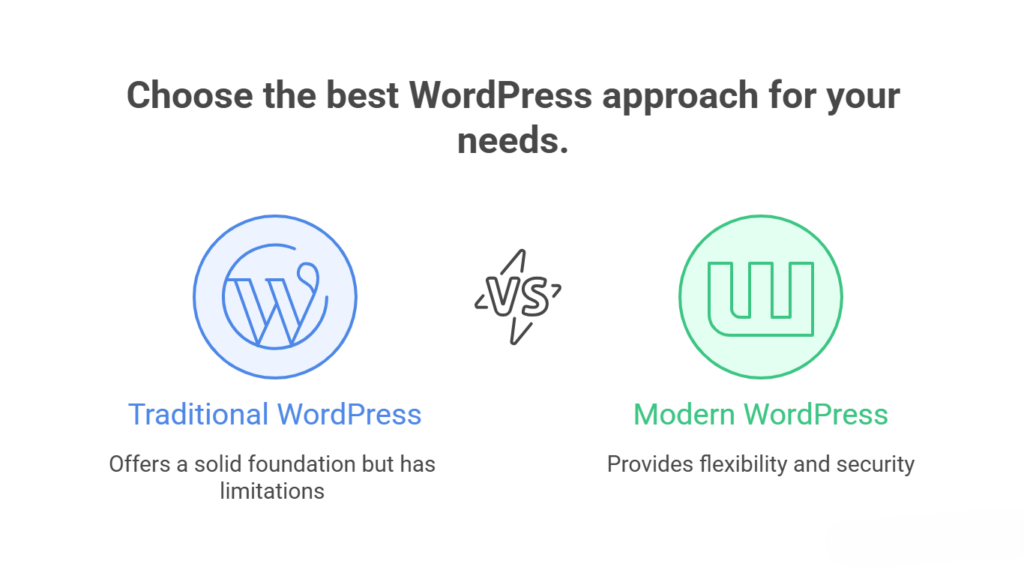
WordPress has been the platform of choice in businesses of all sizes in over a decade. Its simplicity plug-in system and ease of use have seen it become the internet backbone but the digital world has evolved to see companies today demand more regarding user expectations of technology advancements and demand on multi-channel experiences.
Why are more companies leaving the old-fashioned WordPress websites and what they are moving to.
Limitations of Traditional WordPress
Slower Performance with Scale
WordPress is fantastic for small websites but as businesses grow performance issues often arise. Adding multiple plugins or complex themes can make pages load slowly frustrating users and harming search rankings.
Example: A retail brand with thousands of products may experience slower page loads such as WooCommerce SEO and caching plugins to stack up.
Maintenance Overhead
WordPress requires frequent updates core system update’s theme updates plugin updates to stay secure. Managing all of these especially across multiple websites can become a full-time job.
Point to note:
- Security risks increase if updates are delayed exposing websites to hacks.
Limited Multi-Channel Flexibility
Traditional WordPress websites are mainly designed for the web. If a business wants to deliver the same content to mobile apps kiosks or other platforms WordPress can’t handle it natively. Plugins or third-party solutions often only partially solve this adding complexity.
User Experience Challenges
The current users require interactive and personalized experiences in a short time. Without extensively customizing WordPress it might not be able to offer these. The engagement and conversions can be damaging by having slow load times generic templates and low flexibility.
Why Businesses Are Exploring Alternatives
Demand for Speed and Performance
The speed of a Web site is now a vital measure of both search engine optimization and retention. Those companies who have abandoned WordPress are opting to use solutions that support quicker loading and efficient frontends.
Multi-Platform Content Delivery
The brands would like their content to be uniform on the websites mobile apps and other digital channels. This centralization is made possible by headless CMS or modern frameworks to make sure that the updates spread instantly everywhere.
Scalability and Future-Proofing
Businesses expanding into the international markets or digitalization must have scalable platforms. The intention is that modern solutions enable quick implementation of new functionality of multi-language support and high-traffic load which is frequently an issue in traditional WordPress.
Enhanced Customization
Interactive interfaces and dynamic content and user experiences are demanded. The next step to leave WordPress is to enable developers to use the latest frameworks such as React Next.js or Vue.js to develop brand-focused experiences.
What Companies Are Doing Instead
Headless CMS Adoption
Many businesses are adopting Headless CMS to decouple content management from frontend design. This allows content to be reused across multiple channels while enabling fast interactive and scalable websites.
Jam stack and Modern Frameworks
Some brands are moving Jam stack architectures where static site generators APIs and deliver content quickly. This approach improves may performance security and developer flexibility.
Hybrid Approaches
Not all companies abandon WordPress entirely. Hybrid setups allow businesses to retain WordPress for content management while leveraging a modern frontend for speed customization and multi-channel delivery.
Final Thoughts
WordPress continues to be a magnet to numerous websites yet the online demands of the modern users are changing. Firms requiring the speed of scalability multi-platform delivery and premiere user experiences are gradually migrating to the new solutions.
The future does not entail abandoning WordPress in totality instead it is about seeking the appropriate blend of the tools which meet the performance in terms of growth and user experience.
If your website could engage users twice as fast across web, mobile and apps would you stick with convenience or embrace modern flexibility?
Frequently Asked Questions (Why Businesses Are Moving Beyond Traditional WordPress Websites)
Why do companies choose WordPress for large websites?
Companies choose WordPress for large websites due to flexibility extensive plugins scalability ease of content management, strong community support and rapid development capabilities.
Why don’t big companies use WordPress?
Big companies avoid WordPress due to security risks performance limitations scalability challenges heavy maintenance and preference for custom or headless CMS solutions.
Is WordPress being phased out?
No WordPress isn’t being phased out it remains widely used evolving with headless and block‑based features, and still powers a large share of the web.
Is NASA using WordPress?
Yes NASA uses WordPress for several websites and blogs leveraging its flexibility ease of content management and community support.
Leave a Reply