Author: admin

  • Why Cultural Fit Matters More Than Ever in Hiring

    Why Cultural Fit Matters More Than Ever in Hiring

    Hiring the right person isn’t just about ticking off skills on a checklist. It’s about finding someone who believes in your mission, shares your values, and can thrive in your company’s environment. That’s where cultural fit comes in—and in 2025, it’s more important than ever.

    As companies continue to adopt flexible work models and build global teams, hiring someone who “fits in” isn’t just a nice-to-have—it’s essential for long-term success.

    What Is Cultural Fit?

    Cultural fit refers to how well a candidate’s values, beliefs, and working style align with your company’s culture. It’s about more than just personality—it’s about shared purpose and compatibility.

    If your company values collaboration, innovation, and ownership, then hiring someone who prefers solo work, fixed routines, and top-down management might cause friction—even if they’re highly skilled.

    Why It Matters in 2025

    The way we work has changed. Remote work, global teams, and shifting expectations have made cultural alignment even more critical. Here’s why cultural fit has become a major factor in successful hiring:

    • Higher Retention: Employees who feel connected to your culture are more likely to stay.
    • Better Performance: Teams with strong cultural alignment collaborate more easily and stay motivated.
    • Faster Onboarding: Culturally aligned employees adapt quicker and start contributing sooner.
    • Improved Morale: A good cultural match leads to less conflict and more cohesion across teams.

    Skills vs. Culture: It’s Not Either/Or

    Some companies fear that prioritizing culture might lead to hiring the wrong person just because “they’re nice.” But hiring for culture doesn’t mean ignoring skills. It means finding someone who has the right skills and can thrive in your environment.

    In fact, the best hires are both technically qualified and culturally aligned.

    A good hire in 2025 should have:

    • The required skill set or potential to grow into the role
    • Alignment with the company’s mission, values, and work style
    • The ability to work effectively with your existing team
    • Adaptability to your specific business and communication style

    Red Flags of a Poor Cultural Fit

    Even the most experienced candidates can be a poor match if they’re not aligned with your company’s ways of working.

    Watch out for these signs:

    • They speak negatively about past team experiences or collaboration
    • They value job titles more than learning or growth
    • They prefer rigid routines in a fast-moving, flexible company
    • They show resistance to feedback or working in a team setting
    • They don’t ask questions about your company culture during the interview

    Sometimes, the lack of interest in how your team works is a clear sign they may not be invested for the long haul.

    How to Assess Cultural Fit During Hiring

    Cultural fit isn’t always obvious from a résumé. That’s why you need a thoughtful hiring process that goes beyond the surface.

    Here are a few ways to do it:

    1. Ask the Right Questions

    Go beyond technical interviews. Include behavioral and situational questions like:

    • “What type of team do you work best in?”
    • “Tell us about a time you had to adapt to a new culture or work environment.”
    • “How do you handle feedback and communication on remote teams?”

    2. Share Your Company Culture Clearly

    Make your company values, expectations, and working style visible during the hiring process. A culture deck, short video, or real employee stories can help candidates self-assess if they’re a good match.

    3. Involve Multiple Team Members

    Let candidates meet future coworkers or other departments. This gives a more complete picture and helps both sides evaluate chemistry and collaboration styles.

    4. Use Culture-Focused Assessments

    Some companies use personality or values assessments—not to reject candidates, but to guide better team alignment and onboarding.

    Cultural Add vs. Cultural Fit

    It’s important to note that cultural fit doesn’t mean hiring people who all think or look the same. That can lead to groupthink or a lack of innovation.

    Instead, aim for “culture add.” This means hiring people who share your values but bring different perspectives and experiences to the table.

    A culture add can:

    • Challenge existing assumptions
    • Contribute to innovation
    • Make your team more inclusive and dynamic
    • Bring in fresh problem-solving approaches

    This balance between alignment and diversity is the sweet spot for strong teams.

    The Cost of Ignoring Cultural Fit

    Hiring someone who doesn’t align with your culture can lead to:

    • Early resignations or quiet quitting
    • Conflict with other team members
    • Low morale across departments
    • Loss of time, money, and training investment

    The cost of a bad hire can go well beyond salary. It impacts team energy, customer satisfaction, and your employer brand.

    Final Thoughts

    In today’s hiring environment, cultural fit isn’t a bonus—it’s a must. When you bring people into your team who understand your mission, share your values, and fit your work style, you’re not just filling a role. You’re building a team that’s stronger, more connected, and more productive.

    So next time you’re hiring, take a step back and ask:
    “Will this person succeed here—not just on paper, but in our world?”

    That answer could make all the difference.

  • What Is RPO and Why Is It the Future of Scalable Hiring?

    What Is RPO and Why Is It the Future of Scalable Hiring?

    Hiring today looks very different than it did a few years ago. With the rise of remote work, global teams, and talent shortages, companies are under pressure to hire faster and smarter. That’s where Recruitment Process Outsourcing (RPO) comes in.

    Whether you’re a fast-growing startup or an enterprise scaling operations globally, RPO can offer the flexibility, efficiency, and expertise your business needs to stay ahead.

    In this blog, we’ll break down what RPO really is, how it works, and why it’s becoming the go-to hiring solution for modern companies.

    What Is RPO?

    RPO stands for Recruitment Process Outsourcing. It’s a hiring model where a company outsources all or part of its recruitment process to an external partner.

    Unlike traditional staffing agencies that fill individual roles, RPO providers take over your entire hiring strategy—from sourcing and screening to interviews, onboarding, and even employer branding.

    RPO is not just a service. It’s a partnership.

    How RPO Works

    When you work with an RPO provider, you’re getting a dedicated recruitment team that works as an extension of your company. This team gets to know your culture, your goals, and your hiring needs—then builds a process that’s completely tailored to you.

    RPO providers typically handle:

    • Creating or refining job descriptions
    • Sourcing candidates across multiple platforms
    • Screening and initial interviews
    • Background checks and reference calls
    • Offer management and negotiation
    • Onboarding support
    • Recruitment data and reporting
    • Employer brand strategy

    You can choose full RPO (for all hiring needs) or project-based RPO (for specific roles or timelines). There’s also hybrid RPO, which mixes in-house hiring with outsourced support.

    Why RPO Is Gaining Popularity

    The business world is changing fast. Companies need talent strategies that are just as flexible and forward-thinking. Here’s why RPO is becoming the future of scalable hiring:

    1. Faster Time to Hire

    Open roles cost money. Every day without a hire slows down your business. RPO providers already have pipelines, platforms, and expertise to move fast.

    • Reduced time spent sourcing
    • Faster screening and interviews
    • Ready access to pre-vetted talent
    • Streamlined hiring steps

    In many cases, RPO partners can fill roles in a fraction of the time it takes internal teams.

    2. Access to Better Talent

    With an RPO provider, you’re not limited to who applies to your job post. These partners proactively reach out to passive candidates, niche professionals, and global talent pools.

    • More diverse, qualified applicants
    • Candidates with strong cultural alignment
    • Better chances of long-term retention
    • Reduced risk of bad hires

    This focus on quality over quantity means better hires—every time.

    3. Scalable and Flexible Hiring

    Whether you’re hiring five people or fifty, RPO scales with your business. That makes it ideal for fast-growing startups, seasonal hiring, or large expansion projects.

    • Easily ramp up or slow down hiring
    • No need to constantly build internal recruiting teams
    • Predictable hiring costs

    This flexibility makes RPO a smart solution for companies with evolving needs.

    4. Cost Savings

    Hiring in-house can be expensive—recruiters, tools, job ads, software, and training add up. RPO reduces these costs by consolidating them into one predictable service fee

    • Lower cost per hire
    • Less overhead and admin burden
    • Avoids hidden expenses from poor hiring

    Many businesses report saving 30–70% on hiring costs after switching to an RPO model.

    5. Improved Candidate Experience

    In a competitive market, your candidate experience matters. RPO teams focus on communication, professionalism, and speed—so candidates feel respected and informed at every stage.

    • Clear updates and timelines
    • Personalized communication
    • Smooth transitions from interview to offer
    • Stronger employer brand

    Happy candidates—even those who don’t get hired—can become future applicants or brand ambassadors.

    RPO vs Traditional Staffing: What’s the Difference?

    While both models support hiring, they’re built for different goals.

    __wf_reserved_inherit

    RPO is ideal for companies that want to build strong teams, not just fill seats.

    Is RPO Right for Your Business?

    You don’t need to be a giant company to benefit from RPO. In fact, many small and mid-sized businesses are now choosing RPO for its flexibility and efficiency.

    RPO might be right for you if:

    • You’re growing fast and need to scale hiring quickly
    • Your internal HR team is stretched too thin
    • You’ve struggled with poor hires or high turnover
    • You want to improve your hiring process and candidate experience
    • You’re hiring across locations or time zones
    • You need better data and reporting around hiring

    Final Thoughts

    Recruitment is no longer just about filling vacancies—it’s about building high-performing teams that drive growth. As hiring becomes more complex, competitive, and global, companies need smarter solutions.

    RPO is that solution.
    It combines strategy, speed, and expertise into one powerful model—designed to help you grow without the guesswork.

    If you’re ready to rethink hiring, save time, and tap into top talent, it might be time to explore Recruitment Process Outsourcing.

  • Top 5 Hiring Mistakes Companies Make—and How to Avoid Them

    Top 5 Hiring Mistakes Companies Make—and How to Avoid Them

    Hiring the right people is one of the most important things a business can do. The right hire can boost productivity, improve team morale, and help you grow faster. But the wrong hire? It can cost time, money, and even hurt your company culture.

    In today’s fast-moving job market, companies can’t afford to make the same old hiring mistakes. Let’s take a closer look at the top five hiring mistakes businesses still make—and more importantly, how to avoid them.

    Mistake #1: Rushing the Hiring Process

    In a rush to fill a role quickly, many companies end up hiring the first “okay” candidate who checks a few boxes. While speed is important, hiring too fast often leads to poor long-term results.

    Why it’s a problem:

    • You may overlook better candidates
    • You don’t get enough time to properly evaluate fit
    • You might end up rehiring for the same role within months

    How to avoid it:

    • Create a clear, structured hiring process with timelines
    • Take time to screen and interview multiple candidates
    • Involve more than one person in the decision-making
    • Plan ahead so you’re not hiring reactively

    The goal is to hire well, not just quickly.

    Mistake #2: Focusing Only on Skills, Not Cultural Fit

    A candidate may look perfect on paper, but that doesn’t mean they’ll thrive in your team. Many companies focus solely on technical skills and ignore whether the person will actually fit into the culture.

    Signs of poor cultural fit:

    • Misalignment with your company values
    • Struggles to work with the team
    • Low engagement or interest in the role
    • Resistance to your work style (e.g., remote, fast-paced, or collaborative)

    How to avoid it:

    • Include behavioral and cultural questions in interviews
    • Let the candidate meet team members or shadow a meeting
    • Talk openly about your company culture during the hiring process
    • Ask: “Would this person thrive here?”

    Hiring someone who aligns with your mission and work style is just as important as their qualifications.

    Mistake #3: Writing Vague or Unrealistic Job Descriptions

    Job descriptions are your first impression—and often your first mistake. Many businesses post vague, outdated, or unrealistic descriptions that confuse or turn off the right candidates.

    Common issues:

    • Too generic or full of jargon
    • A laundry list of skills and tasks that don’t reflect the actual role
    • No mention of company culture, growth opportunities, or values
    • Lack of clarity on what success in the role looks like

    How to avoid it:

    • Write clear, honest, and engaging job descriptions
    • Focus on outcomes—what will the person actually do and achieve?
    • Highlight your company’s culture, benefits, and values
    • Limit “must-haves” to actual requirements

    A good job description attracts the right people and sets clear expectations from day one.

    Mistake #4: Not Having a Structured Interview Process

    Winging interviews may work in movies—but not in real life. Unstructured interviews often lead to biased decisions, missed red flags, and hiring mistakes.

    Risks of unstructured interviews:

    • Inconsistent candidate experience
    • Difficulty comparing candidates fairly
    • Over-reliance on gut feelings
    • Missed opportunities to assess key skills or behaviors

    How to avoid it:

    • Use a structured interview format with predefined questions
    • Align questions with the role and your company’s values
    • Include both technical and behavioral assessments
    • Train your interviewers to evaluate objectively

    Structure helps remove bias and makes your hiring process more fair and effective.

    Mistake #5: Ignoring the Candidate Experience

    Even if you don’t hire someone, their experience still matters. Poor communication, long delays, or impersonal interviews can damage your employer brand—and cause top candidates to walk away.

    Poor candidate experience includes:

    • Long gaps between interview stages
    • No follow-up or feedback after interviews
    • Confusing or disorganized processes
    • Not showing respect for the candidate’s time

    How to avoid it:

    • Communicate clearly and consistently throughout the process
    • Set expectations about timelines and next steps
    • Provide feedback, even if it’s a “no”
    • Treat candidates like people, not just applications

    A great candidate experience builds trust and can lead to future referrals—even from people you don’t hire.

    Final Thoughts

    Hiring mistakes happen—but they’re avoidable. In today’s competitive market, companies that hire with intention, clarity, and care will always come out ahead.

    To recap, here are the top 5 mistakes to avoid:

    1. Rushing the hiring process
    2. Ignoring cultural fit
    3. Writing vague job descriptions
    4. Skipping a structured interview process
    5. Neglecting the candidate experience

    Hiring is more than just filling a seat—it’s about building a team that drives your business forward. Slow down, stay thoughtful, and make each hire count.

  • The Future of Recruitment: Trends Every Business Should Watch

    The Future of Recruitment: Trends Every Business Should Watch

    Recruitment isn’t what it used to be—and that’s a good thing. With changing work cultures, evolving technology, and shifting employee expectations, the way businesses hire is going through a major transformation.

    In 2025, staying ahead in recruitment means more than just posting job ads and screening résumés. Businesses that understand the new trends are the ones attracting the best talent—and keeping them. This blog explores the top recruitment trends every business should keep an eye on.

    Why the Recruitment Landscape Is Changing

    We’ve moved past the era of generic job portals and lengthy hiring processes. Today’s workforce is more diverse, digitally connected, and values-driven. Candidates are looking for more than just a paycheck—they want purpose, flexibility, and growth.

    At the same time, companies need to hire faster, smarter, and more efficiently in a competitive market.

    1. Remote Hiring Is Here to Stay

    The remote work revolution has changed hiring forever. Companies are no longer limited by geography. In fact, remote hiring opens access to global talent pools and helps businesses build more diverse teams.

    What this means for recruiters:

    • Interviews are now mostly virtual
    • Onboarding processes are remote-friendly
    • Time zones and asynchronous work need to be considered
    • Soft skills like communication and self-management matter more than ever

    To stay competitive, businesses must build remote-ready recruitment processes that prioritize clarity, culture, and collaboration.

    2. AI and Automation in Recruitment

    Artificial Intelligence (AI) is reshaping how companies find and filter candidates. While AI won’t replace recruiters, it can make their work faster and more accurate.

    How AI is being used in hiring:

    • Screening résumés and ranking candidates
    • Chatbots for candidate communication
    • Video interview tools that analyze tone, confidence, and communication
    • Predictive analytics to improve hiring decisions

    However, it’s important to keep the human touch. Automated tools should support recruiters—not replace them.

    3. Skills Over Degrees

    More companies are shifting their focus from education to skills. This is especially true in tech, design, and digital roles where portfolios and practical knowledge matter more than formal degrees.

    What to expect:

    • Job descriptions will prioritize skills and outcomes
    • Online certifications and bootcamps will gain more value
    • Tests, case studies, and project-based assessments will become more common
    • Micro-credentials (small, skill-based certificates) will become part of hiring criteria

    ‍

    Hiring for potential, adaptability, and soft skills is becoming just as important as hiring for experience.

    4. Employer Branding Matters

    In a world full of job options, candidates want to know what makes your company different. A strong employer brand can be the deciding factor for top talent.

    Ways to build a strong employer brand:

    • Showcase team stories and culture on your website and social media
    • Be transparent about company values, benefits, and growth opportunities
    • Improve the candidate experience—from first contact to onboarding
    • Collect and display testimonials from current employees

    Remember, your hiring process is a reflection of your brand. Make it memorable—for the right reasons.

    5. DE&I Will Drive Strategy

    Diversity, Equity, and Inclusion (DE&I) is no longer a checkbox—it’s a core business priority. Candidates care deeply about inclusive workplaces, and companies are being held accountable.

    How DE&I is shaping hiring:

    • Inclusive language in job descriptions
    • Blind résumé reviews to reduce bias
    • Structured interviews to ensure fairness
    • Outreach to underrepresented talent communities

    Investing in DE&I not only improves your team—it also enhances innovation, performance, and company reputation.

    6. Faster Hiring Through RPO and Staffing Partners

    The talent market is moving fast, and businesses need to respond quickly. That’s where Recruitment Process Outsourcing (RPO) and staffing partnerships come in.

    Companies are increasingly turning to expert partners to:

    • Reduce time-to-hire
    • Access larger talent pools
    • Scale hiring without straining internal teams
    • Improve quality of hire with pre-vetted candidates

    In 2025, outsourced hiring is no longer just for big companies—it’s a smart solution for businesses of all sizes.

    7. Data-Driven Decision Making

    Recruitment teams are becoming more analytical. Instead of relying on gut feeling, hiring decisions are now backed by data.

    Metrics that matter:

    • Time to fill
    • Cost per hire
    • Quality of hire
    • Source of hire
    • Candidate satisfaction scores

    ‍

    By tracking the right data, companies can continuously improve their recruitment strategy—and reduce costly hiring mistakes.

    8. Employee Referrals and Internal Mobility

    Referrals are still one of the best sources of quality hires. At the same time, companies are focusing more on growing talent from within.

    What this looks like:

    • Encouraging employee referrals with rewards
    • Promoting internal job opportunities
    • Upskilling current employees instead of hiring externally
    • Building career development paths to boost retention

    These approaches not only cut hiring costs but also build loyalty and boost morale.

    Final Thoughts

    The future of recruitment is fast, flexible, and human-centered. From remote hiring and AI to employer branding and diversity, businesses need to embrace change to attract and retain the best people.

    If you’re still relying on old-school methods, now is the time to evolve. The talent market is moving quickly—and the companies that adapt will lead the way.

    Whether you’re a growing startup or an established enterprise, keeping up with recruitment trends isn’t optional—it’s essential.

  • How to Build a High Performing Remote Team in 2025

    How to Build a High Performing Remote Team in 2025

    Remote work is no longer just a trend. It’s the new normal. As we step into 2025, businesses of all sizes are embracing remote teams to access global talent, reduce overheads and offer flexibility to employees. But building a successful remote team is more than just hiring people who work from home. It requires strategy, structure and the right tools.

    In this blog, we’ll walk you through the key steps to building a high-performing remote team in 2025—from hiring to culture to communication.

    Why Remote Teams Are the Future

    Remote work has changed how businesses think about productivity and team building. With better internet access, communication tools and flexible work policies, companies can now hire top talent from anywhere in the world.

    But flexibility doesn’t mean lower standards. In fact, the best remote teams are often more productive, more engaged and more efficient than traditional office teams. If built the right way.

    Step 1: Hire the Right People

    Hiring for a remote team isn’t the same as hiring for an in-office position. You need people who are self-motivated, good communicators and comfortable working independently.

    What to look for in a remote candidate:

    • Strong written and verbal communication skills
    • Self-discipline and time management
    • Experience with remote tools like Slack, Zoom, or Asana
    • Ability to work across different time zones
    • Problem-solving and decision-making skills without micromanagement

    Use structured interviews and practical tests to evaluate candidates’ remote-readiness. It’s also helpful to assess cultural fit and values, especially in a distributed setup.

    Step 2: Set Clear Expectations from Day One

    When team members are not in the same room, miscommunication can happen easily. That’s why clarity is key.

    Be clear about:

    • Working hours and availability
    • Project timelines and deadlines
    • Communication norms (e.g. when to use email vs chat)
    • Performance metrics and goals

    Create a remote employee handbook or onboarding guide. It helps new hires understand your processes and feel aligned with the team early on.

    Step 3: Use the Right Technology

    In 2025, remote work tools are smarter and more advanced than ever. Use them wisely to enable collaboration and track progress.

    Must-have tools for remote teams:

    • Communication: Slack, Microsoft Teams, Zoom
    • Project management: Trello, Asana, Monday.com
    • Document sharing: Google Workspace, Notion, Dropbox
    • Time tracking: Hubstaff, Clockify, Toggl
    • Feedback & engagement: Officevibe, 15Five, Lattice

    Make sure everyone on the team is trained on how to use these tools effectively. The goal is not to overload people with apps—but to make collaboration smooth.

    Step 4: Build a Strong Remote Culture

    One of the biggest challenges in remote teams is building a sense of belonging. People can feel disconnected if culture is ignored.

    Tips to create a great remote culture:

    • Schedule regular team check-ins and one-on-one meetings
    • Celebrate small wins, birthdays and milestones
    • Encourage casual conversations (e.g. virtual coffee breaks)
    • Be transparent about company goals and updates
    • Offer personal development opportunities

    A strong culture helps reduce turnover and increases trust across the team.

    Step 5: Focus on Outcomes, Not Hours

    Remote work offers flexibility—but with that comes the need to trust your team. Instead of tracking hours, focus on results.

    Define clear goals and measure performance based on output. This gives employees more ownership and makes them feel empowered to deliver their best.

    Managers should avoid micromanaging and instead offer support, mentorship and accountability.

    Step 6: Support Mental Health and Work-Life Balance

    Burnout can be real in remote environments, especially when work blends into personal life. Leaders need to be proactive about employee well-being.

    Ways to support your team:

    • Promote regular breaks and time off
    • Offer wellness programs or mental health days
    • Encourage flexible schedules where possible
    • Set boundaries around after-hours communication

    When employees feel cared for, they’re more likely to stay motivated and loyal.

    Step 7: Keep Evolving

    The way we work remotely is always changing. What worked last year may not work today. Stay open to feedback and adjust your processes regularly.

    • Run anonymous surveys to check team satisfaction
    • Ask for feedback after major projects or team changes
    • Revisit your tools and systems every quarter

    A high-performing remote team is one that’s continuously learning and improving.

    Final Thoughts

    Building a high-performing remote team in 2025 isn’t about copying office life—it’s about creating a new kind of workplace. One that values trust, flexibility, communication and culture.

    Whether you’re building your first remote team or scaling an existing one, remember that your people are your biggest asset. Hire with intention, lead with empathy and always keep evolving.

  • Integriti helps Fortune 500 employer build a high-performing Agile software development team

    At the onset of COVID-19, our large Fortune 500 retail client faced a problem. The Pandemic had shifted consumer behaviors overnight. Retail had been significantly impacted. In response to restrictions consumers scaled back on in-store shopping and went online instead. Globally companies’ heavily focused on fortifying their web presence. E-commerce was now critical to the bottom line and competitiveness of retail.

    Online sales of household appliances such as electronics, building materials, and DIY supplies have skyrocketed since the outbreak of COVID-19 in Canada. Sales within this sector increased by 625% between March 11th and May 3rd, 2020, compared to the same period in 2019.

    Talent shortage

    The Home Depot Canada faced a talent shortage in May 2020. The company required skilled developers to continue enhancing the HomeDepot.ca e-commerce portal and respond to massive growth in online sales.

    “Recently, due to rapid increase in online sales, we had a need to fill multiple positions in our ecommerce development team. Integriti responded. The service, quick turnaround, and quality of developer talent was nothing short of impressive. I would not hesitate to recommend Integriti.” – Hiring Manager, The Home Depot Canada

    We submitted a full team with Java Developers, AngularJS Front-End Developers, Android Mobile Developers, Architects, DevOps Engineers, Incident Managers, and QA Engineers.

    Angular developers

    Using our wide network of Angular developers, we make required talent available immediately. We respond swiftly to fill resource shortages and remove risk from all development projects.

    Angular was a critical-path requirement for The Home Depot Canada. Integriti was uniquely positioned to quickly build them a team of Angular Developers.

    “They know what we need, and they’re able to quickly deploy Angular Developers. Their talent pipeline is robust and market knowledge is insightful. Developers from Integriti have hit the ground running.” – Hiring Manager, The Home Depot Canada

    As an RPO (Recruitment Process Outsourcing) company we provide our clients with full lifecycle support. We manage everything from recruitment to onboarding. This includes:

    • Rapid deployment, especially for Angular and Android Developers
    • Short-term and project-specific contract staffing
    • On-demand conversion to full-time employment
    • Industry-leading technology
    • Payroll processing
    • Reporting and metrics
    • Candidate care
  • Layered architecture: What it is and how it can help you create applications?

    Application Layer Diagram

    What is web application architecture?

    Application architecture is the representation of how different services and systems are joined together. It helps us to understand how applications or services are placed in a layered architecture, who are the different actors at each layer and what is the fundamental role of each layer.

    It determines application components and different layers communicate with each other. These architectures are layered having different layers from the design or presentation layer to the data layer. Software architects or Web engineers ensure that all the elements or layers work together correctly.

    How does system architecture for web application works?

    In web application architecture, there are basically two parts working simultaneously, the client (frontend) and server (backend). The client represents the application UI on the browser from where the web server takes the request to the server, where the server has the code that responds to requests coming from the client. The Server manages the application logic and responds to HTTP requests.

    Models of web architecture

    One-tier architecture

    One-tier architecture involves putting all of the required components for a software application or technology on a single server or platform. This kind of architecture is often contrasted with multi-tiered architecture or the three-tier architecture that’s used for some Web applications and other technologies where various presentation, business, and data access layers are housed separately.

    Diagram of one-tier architecture

    Two-tier architecture

    The Two-tier architecture is divided into two parts: Client Application (Client-side) and Database (Server-side) respectively.

    Also called a client-server application, the communication in this architecture takes place between the client (browser) and the server. The client system will send the request to the server system which will process it and send back the data to the client side.

    Diagram of Two-tier architecture

    Multiple-tier architecture

    A Multi-tier Architecture is a software architecture in which different software components, arranged in tiers (layers), offer dedicated functionality. The most common example of multi-tier architecture is a three-tier system comprising a data management tier (encompassing one or several database servers), a client tier (interface functionality), and an application tier (business logic).

    Diagram of Multiple-tier architecture

    Microservices architecture

    You might have heard of the word microservices if you’re a tech enthusiast. Microservices are independent services like applications, which exist completely on their own. These come with their logic, state, and deployment and interact with each other via API calls, queues, etc. depending on the requirements. These microservices combine to deliver the complete application solution.

    With microservices architectures, applications are easier to scale and faster to develop allowing businesses to accelerate innovation and time-to-market for new features.

    Diagram of Microservices Architecture

    Layers and Components of Application Architecture

    The application architecture is made up of several layers: design layer, frontend layer (HTML and CSS), backend or data layer (database and scripting languages), platform (browser/OS), and business layer. These layers are built on top of each other and depend on each other to create a successful project.

    Presentation Layer

    This layer represents the design and UI components on the client side. Users interact with this layer to send requests through the application layer to the server. It displays the data flow for the users. The main purpose of this layer is to take data from users and show the response from the server (data layer).

    Our UI team can help you create the right experience to help your business attract customers’ attention.

    Application Layer

    The application layer consists of an API gateway. Front-end developers write code to pass the data from the presentation layer to the business logic layer where it is processed. Data will pass to APIs and get stored in the database, depending on the feature it is utilized in the business layer for application logic and to perform certain actions.

    Business Layer

    This layer has all implementation of application logic. Data from the application layer gets utilized here for example in a lead generation application a form is submitted in the presentation layer and data travels through APIs and is then used to send out emails or to perform any action on the lead before getting stored in the database.

    Data or Backend Layer

    All the data gets stored in the database and retrieved from it to use on the front end (client-side). Data travels from the database through APIs, from the application layer in creating modules or components that are converted to UI and the user then interacts with that in the presentation layer.

    Conclusion:

    To conclude, there are different ways to set up the architecture for applications software. Microservices architecture is the most popular choice of mid-sized and large companies like Amazon and Google. However, in order to find out more about which architecture to go with for building your project we recommend you reach out to any professional web development team that can guide you according to your needs and goals.

    Want us to help you build your next big product? Contact us.

    ‍

  • Most Globally In-Demand Programming Languages, 2021.

    How do you choose a programming language from the plethora of options available?

    Mastering a new programming language can help you advance further in your career or switch careers completely. But you might be wondering how to make the right choice. After all, you will likely have to invest your time and money to learn it. The sheer number of programming languages out there does not help the situation either. This decision will likely involve several considerations like your past knowledge and coding skills, the difficulty level of a language, and your reasons for learning a new language in the first place.

    Another thing you should keep in mind while deciding on a programming language is employers’ demand. If you are aiming to work for big tech giants, then we suggest prioritizing programming languages that have earned their stripes. In fact, in our blog on most In-Demand web frameworks for 2021, we helped you choose the “right” framework by highlighting the needs of your potential employers. Following the similar approach here, we will be sharing In Demand programming languages for the year.

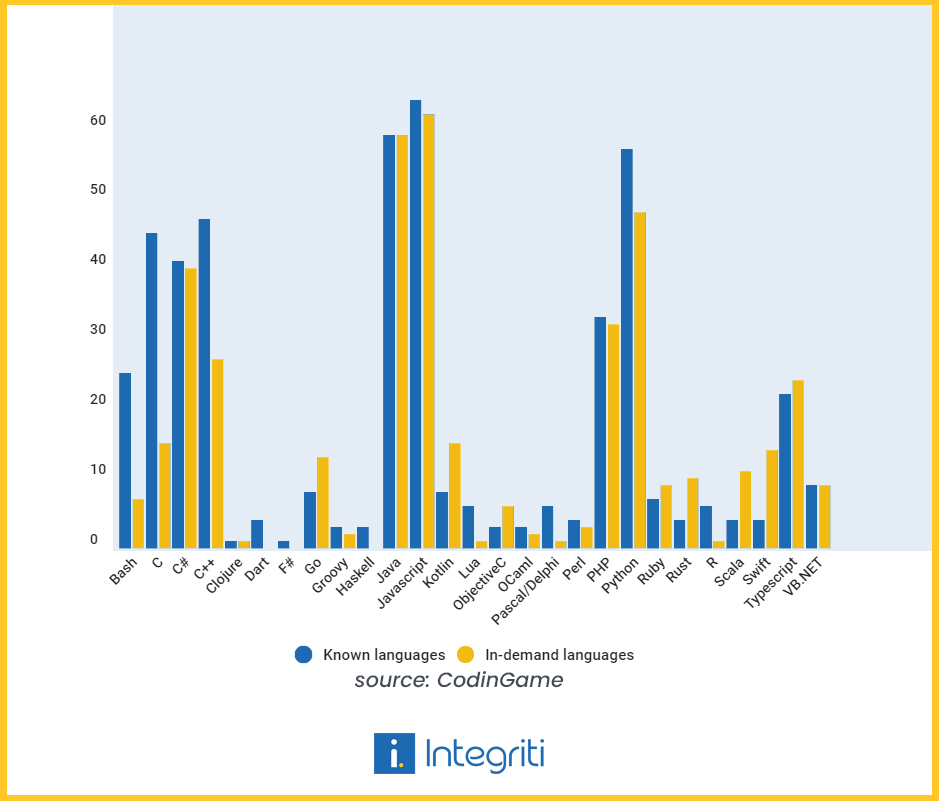
    A recent survey by CodinGame sheds light on the popularity of programming languages and their demand by employers. According to the results, more than half of the programmers knew how to code in JavaScript, Java, and Python. These three continue to be the most widely used programming languages in the world.

    A survey about most in demand programming languages

    On the demand side, results showed that close to 60% of the tech recruiters were on the lookout for professionals working with JavaScript and Java. These findings signal that the programmers and employers are in sync at least when it comes to these two languages. However, the same cannot be said for other languages like C, Python, etc. The demand for these languages is less than their popularity among programmers. For example, 57% of developers code in Python, but only 48% of companies need Python development. This gap is even bigger for C. 45.1% of programmers code in C however only 15.4% of companies require C development.

    These insights highlight how most tech companies favor 4 programming languages: JavaScript, Java, Python, and C#. In our opinion, it’s better to stick with JavaScript as it’s the most popular programming language for a reason. As a matter of fact, JavaScript development also made it to our list of Top Ten Tech skills in Canada for 2021! Most companies developing web UIs need to interface with JavaScript. Moreover, with the introduction of NodeJS, it’s also being used to develop server-side applications as well. If you want to learn a lesser-known language to stand out, then consider TypeScript. This past October, TypeScript was named among the fastest-growing languages in GitHub’s Octoverse Report. The results also showed a small shortage for this language as 24% of companies needed TypeScript development but only 22% of developers knew it.

    The survey overall highlights the dominance of few major programming languages like Java, JavaScript, and Python. The results also suggest a surplus of developers dealing with Python and C. For these developers, it would be better to switch to other languages to improve their job prospects in this competitive environment.

  • Press Release: Integriti Group Rebrands

    On 17 Oct 2022, we are happy to announce to you the launch of the new Integriti logo and website as part of the ongoing evolution of our company’s brand.

    The main image of Integriti Group unveils a brand new look blog post

    ‍

    Following the breakout growth of our digital marketing and software development services over the past year, our team has been busy updating our visual identity to reflect our new capabilities and the vision of engineering growth for our clients.

    We believe that in today’s globally interconnected world and with the rise of digital transformation, enterprises need smart technology solutions to achieve operational efficiency, business growth, and competitive disruption. Not only do they require flexible solutions but also visionary partners like Integriti that can speak their language.

    Today, we’re proud to be a trusted partner of leading organizations and to have delivered successful outcomes in a variety of projects ranging from designing an enterprise knowledge-sharing system to developing a large e-commerce platform. Complementing our industry-leading software development expertise, we provide UX/UI design and content marketing through our high-performing and results-driven marketing team, also known as “Magnetic Marketing”.

    With Integriti embarking on a new journey and providing more exciting solutions, we believe this is the right time to create a new brand look that allows us to tell our multi-service story better. We also want our brand to be reflective of our promise of seamless communication, real collaboration, and cultural alignment with our clients.

    The New Integriti Has Arrived.

    Our challenge was to honor Integriti’s identity while making the new branding reflective of the company’s growth. We have retained the “i” in Integriti from the older logo and have created a more vibrant, bold, and modern design. Without going far from the old identity, our new logo successfully communicates our growth-oriented spirit and our varied range of services.

    Brand Elements

    “i” for Integriti

    Our brand mark, the “i” in Integriti represents order, trust, and stability which is why it is the center of attention in the logo design. Itis reflective of not only the integrity with which we serve our clients but also embodies our penchant for innovation.

    Color Palette and Gradient

    A gradient represents a direction of maximum change. We have used colour gradient comprising of blue and purple to reflect our two major services of Software development and Digital marketing respectively.

    Font Changes

    We wanted our font choice to be more dynamic, bold, and modern. Without straining too far away from the old identity, we have selected a more symmetrical Sans Serif font to blend in with our overall branding.

    Revamping our website

    We have also revamped our website according to the new brand identity and are continuously working to improve the user experience. The new site offers informative content on our services in a more clean and organized layout to ensure a positive user journey. The new brand identity and website are designed to further elevate Integriti as we continue to provide leading-edge digital solutions for our current and upcoming customers.

  • Secrets of performance-oriented frontend development

    When a web page takes longer than three seconds to load, 40% of visitors leave, increasing the bounce rate.

    Similarly, a slow mobile app would also have poor performance and irritate consumers. After a few tries, the customer will remove your application and download a more user-friendly one.

    The ease of use and user-friendliness of your specific digital solution have a direct impact on the performance of the app. If compromised, it degrades the user experience and lessens the likelihood that users will engage frequently or stay connected to the app or website over time.

    On the other hand, developing a web or mobile app with front-end performance in mind increases the chance that your product will succeed. As a result, your priority should be to create an app or website that loads quickly, is SEO-friendly, performs well, and is well-designed.

    Here are a few secrets that can help you build up your performance-oriented front-end development.

    Optimize Images & Use WebP

    Images are a crucial component of web pages. Considering they increase user engagement, 93.7% of websites on the internet employ at least one image file format.

    The drawback of using images is that, unless they are optimized, they have a negative impact on the front-end loading time. However, there are various approaches to optimizing images:

    Use AVIF or WebP

    Compared to previous formats like JPEG and PNG, using modern image formats like WebP and AVIF shows better performance. When compared to JPEG and PNG, WebP is between 25% and 35% smaller. AVIF is 20% and 50% smaller than WebP and JPEG, respectively.

    The browser support is the drawback, though. WebP acquired browser support only recently, so older versions may not support it. In contrast, Chrome and Opera are the only browsers that support AVIF. As a result, you must utilize the <picture> element in native HTML with fallback support.

    Serve images of the right dimensions.

    Using responsive images is another approach to speed up a website’s performance and cut down on image delivery time. Mobile and tablet devices account for more than 50% of all traffic. The frontend loading time could be further reduced by scaling the image to popular device dimensions and serving it using a srcset.

    There are numerous other methods you can use to speed up the frontend loading time through image optimization in addition to picking the right format and dimensions. Additional recommended best practices are:

    • Use of progressive JPEGs.
    • Use of HTTP/2 instead of HTTP/1.1.
    • Use of image sets.
    • Image Compression
    • Serve smaller images to users on slow connections.

    Compress Files & Use CDNs

    Building a lightweight front end for your web or mobile solution is made much easier with the use of content delivery networks, or CDNs. These web directories have a successful global network. Your app will load more quickly if you use files hosted on CDNs since you can use the cached versions of the files from the closest servers. It enables you to quickly serve more users while preventing bottlenecks.

    Compressing the files to be used comes next after using common files from CDNs. Every file, including documents, images (JPEG, PNG), videos, audio clips, and presentations, can be compressed to enhance the functionality of your application. There are many compression tools available on the market that might be deployed for this.

    Once you’ve completed these two steps, your website or application will be much more responsive to consumer inquiries.

    Bundle & Minify Assets

    Two different performance improvements you may use in a web app are bundling and minification. By minimizing the amount of the requested static assets and decreasing the number of server requests, bundling and minification combined enhance performance.

    Multiple files are combined into one file by bundling. The quantity of server requests required to render an online asset, such as a web page, is decreased via bundling. Numerous unique bundles made expressly for CSS, JavaScript, etc. are possible. Having fewer files means that the browser will make fewer HTTP requests to the server or to the service that hosts your application. As a result, first-page performance is enhanced.

    Code that has undergone minification has unnecessary characters removed without affecting functionality. As a result, the size of the requested assets is significantly reduced (such as CSS, images, and JavaScript files). One of the most frequent side effects of minification is the reduction of variable names to one character, as well as the removal of comments and extraneous whitespace.

    Bundling and minification mainly speed up the first page request load time. After a web page has been requested, the web browser caches the static assets (JavaScript, CSS, and images). Therefore, bundling and minification don’t enhance performance when the same page, or pages, on the same site, are requested with the same assets. If bundling and minification aren’t used and the expires header isn’t set correctly on the assets, then the browser’s freshness heuristics mark the assets stale after some days. The browser also requires a validation request for each asset. Bundling and minification in this situation increase performance even after the initial page request.

    Use Caching and prefetching

    Pre-fetching and caching are two essential tools for front-end web performance. Pre-fetching involves pre-loading resources such as images, scripts, and stylesheets so that they can be delivered to the user more quickly. Caching, on the other hand, involves storing assets on the user’s device so that they don’t have to be requested from the server every time the user visits the site.

    Both of these techniques have a huge impact on website performance and user experience. By pre-loading resources and caching assets, sites can load faster and be more responsive, leading to improved performance and better user experience. Additionally, pre-fetching and caching can reduce the burden on the server, which can help to keep costs down and make sites more resilient.

    So if you want to improve your site’s performance and user experience, be sure to take advantage of pre-fetching and caching.

    Reduce The Number Of Server Calls.

    Generally speaking, the more requests your front end sends to the server, the longer it takes to load. This is due to the fact that sending any request to the server demands full communication before the page can be rendered. There are several approaches you may take to cut down on the number of server requests required to load the website.

    One of the simplest ways to cut down on server calls is to use CSS Sprites. Sprite loads a single image file combined using a collection of images rather than ten separate images to the site. The background image and background-position CSS properties can be used to display the desired image segment. By doing this, you’re minimizing the number of server requests necessary.

    Reducing third-party plugins is also important as they make up a large number of external requests and cutting down on them will boost your application’s loading speed. Preventing broken links to files that don’t exist can also help.

    You might also consider server-side rendering to accelerate the application’s initial load time.

    Making the initial move is never easy. The future, however, belongs to those who aren’t scared to innovate and redefine conventional approaches. You can ensure that your website loads quickly and offers a positive user experience by using these web performance optimization approaches. Just be sure to keep everything simple, smart, and seamless. And keep in mind that you only have 15 seconds to make an impact!

    First impressions of apps and websites are based on their user interface (UI) and front-end. The ease of use, seamless navigation, and fast loading are just a few of the elements that determine whether a user will use your digital product again. Therefore, it’s crucial to consider a web solution’s performance efficiency, whether it’s an App or an e-commerce website. You will be able to do so by using the advice we’ve provided above.

    ‍