Category: integriti.io

  • Importance of modern JS frameworks and SPAs

    When it comes to modern front-end web development, how essential are JavaScript Frameworks?

    In computer programming, a framework is a foundation over which programmers build their software. A JavaScript framework would provide similar assistance. It provides a set of prewritten code enabling developers to use the framework as a structure for the JavaScript program or application without having to start from scratch. These frameworks are easier to apply as most applications and websites have some common features. Hence, they provide businesses with a great opportunity to reduce their development time and make the task less laborious for the development team.

    So, just as the skeleton is important for the support and shape of the human body, JavaScript frameworks are essential for providing a foundation for a given website or application.

    When we talk about modern JS frameworks, there are three in particular that we must discuss given their popularity and importance and building scalable interactive web applications.

    • Angular
    • React
    • Vue.js

    Let’s dig deep into each of these.

    Angular Framework

    Developed by Google, Angular is an open-source web application framework written in TypeScript and used for developing single-page applications (SPA).

    The features offered by this framework are:

    • Free control over adaptability.
    • Capability to meet huge data requirements.
    • Data binding & Dynamic rendering.
    • Simple, declarative, and effective templates (with easier DOM manipulation & two-way binding).
    • Instant help and feedback related to Angular with practically every IDE.
    • Intuitive API and ability to reuse the code to meet a particular development target.

    React Framework

    Most Popular JavaScript Frameworks
    Image Source: Google Trends

    Introduced in 2013, React is a reusable framework created by Facebook. According to Google Trends, React is one of the most popular frameworks. It is ideal for developing interactive user interfaces and offers features like:

    • Virtual DOM Model facilitating easy integration with applications.
    • Reusable components making website or application development simpler.
    • One-way flow of data (more intuitive than bi-directional data binding).
    • Reload feature which allows users to immediately see the applied changes.

    Vue.js Framework

    A free open-source JavaScript framework, Vue.js is a progressive front-end framework that is approachable and easy to learn. Despite being a relatively new framework, it has already earned popularity due to its various features and is suitable for developing both small and large applications. Vue.js has the following features:

    • Reusable codes & predefined options for custom elements.
    • Employs an MVVM structural pattern to separate the GUI from the model’s business logic.
    • Dual integration mode to build high-end SPA.

    Which JS framework is the best?

    When it comes to web development, JavaScript continues to be the leading programming language even today. There are several frameworks, other than the three we mentioned, with their unique features, advantages, and drawbacks.

    However, out of all of these, there is no “best” JS framework.

    Each website or application comes with its own specific requirements which need to be decided before choosing an ideal framework. Remember, each framework has some exclusive features, and it is crucial to evaluate which one matches your requirements best.

    When working for our software development clients at Integriti, we first sit down to discuss project requirements and then evaluate each framework accordingly. We also consider a framework’s complexity, learning curve, and compatibility documentation before making a choice.

    How to make the right framework choice?

    JavaScript frameworks are key to optimizing the entire web development process and saving time, effort, and money. However, there is not one framework that is the perfect match for all projects.

    How are you going to make the right framework choice for your project and ensure a more efficient development process?

    To find the right framework, you need to consider four factors.

    • Existing Toolstack.
    • Complexity
    • Performance Requirements
    • Technical Competence

    Let’s explore each of these in detail below.

    Existing Toolstack

    It is important to make sure that the framework you are considering is compatible with the front-end programming language of the project. For example, if Java or Python is being used then you must select from their respective frameworks.

    If you’re looking to apply a framework to a pre-existing site, then more factors come into play. For instance, you need to consider the time and resources needed to build a new website with a framework as opposed to implementing that framework in an already existing code.

    Complexity

    Some frameworks can support large applications while some are suitable for building SPAs. Hence, you need to understand and evaluate the scope of the project before selecting a framework best suited to your project requirements.

    Performance requirements

    Another factor that you need to consider is the speed of your website. Some frameworks prioritize quick responses due to their focus on virtual DOM. On the other hand, if your project requires more built-in functions and control then a more robust framework would be a better choice.

    Technical Competence

    Some JavaScript frameworks are easy to learn and implement while others are more complicated but offer extra features. If you must use a framework soon, then an easy-to-use framework would be a better choice depending upon the proficiency of your team. However, if you are not short on time then a more complex framework can be beneficial in the long run.

    When deciding on the right JavaScript framework for your project you might not need to be restricted to one framework. If a project is using microservices architecture, then it might be worthwhile to use multiple frameworks.

    These decisions are critical for optimizing your web development process and should be taken after consulting with a tech professional.

    Single-page applications

    Single-page applications are applications that work inside the browser and do not need page reloading in the course of use. SPAs are part of your everyday use and include examples like Gmail, Google Maps, GitHub, and Facebook. They serve an exceptional UX by trying to replicate a “natural” environment in the browser with no page reloads and extra wait time etc. Basically, it’s one web page that you visit which then loads other content utilizing JavaScript.

    SPAs are heavily dependent on JavaScript.

    They request the markup and data independently and render pages up front in the browser. We can achieve this by using advanced JavaScript frameworks like Angular, Meteor.js, Ember.js, Knockout.js, etc.

    Single-page sites are important in today’s digital age because they help keep the user in a comfortable web space where content is displayed in a simple, easy, and effective manner. They offer a much better user experience as you can easily navigate through content without waiting for the pages to load.

    The major distinction between multi-page and single-page applications is that SPAs download the page a single time. SPAs are also much faster in terms of interactivity because when a user interacts with the app, only the required component is modified not the complete application.

    Modern JS frameworks are essential in helping business optimize their web development process. They can help you save on time and costs when developing web applications. This is especially true for developing single-page applications (SPAs) which are very much in demand due to the fast speed of operations they offer.

    If you are looking for a partner for your front-end development project, get in touch with us here.

    ‍

  • Integriti Group, Inc. receives 2023 Best of Staffing Talent Award

    INTEGRITI GROUP INC. RECEIVES 2023 BEST OF STAFFING TALENT AWARD

    ‍

    Mississauga, ON (February 16, 2023)– Integriti Group Inc., a leading staffing agency, announced today that they have won the Best of Staffing Talent Award for providing superior service to their candidates. Presented in partnership with presenting sponsor Indeed and gold sponsor Talent.com, ClearlyRated’s Best of Staffing® Award winners have proven to be industry leaders in service quality based entirely on ratings provided by their candidates. On average, job seekers who work with winning agencies are [1.8 times OR 80%] more likely to be completely satisfied with the services provided compared to those placed by non-winning agencies. Integriti Group Inc. received satisfaction scores of 9 or 10 out of 10 from 72.2% of their placed job candidates, significantly higher than the industry’s average of 45%.

    “The pandemic has accelerated the pace of digital transformation. Top IT talent acquisition and retention continue to be key factors in staying competitive and increasing speed to market. Integriti continues to make its mark by providing highly skilled software engineers to customers, onsite, remote and through our global delivery team.The third win in a row shows that we are headed in the right direction, and I feel proud to have been recognized by ClearlyRated for our commitment to building engaged engineering teams”. said Kamran Azam, Partner, Integriti Group.

     “Winning this industry-recognized award for a third year is a testament to our team’s dedication to the candidate experience. We work with highly talented software professionals. At each stage of their journey our candidates feel fully valued and appreciated by everyone at Team Integriti. I’d like to thank the staff augmentation team for providing a seamless placement experience to our candidates and ClearlyRated for recognizing the team’s effort.” said Omer Husain, Partner, Integriti Group. 

    “I am pleased to introduce the 2023 Best of Staffing winners alongside their validated service ratings on ClearlyRated.com,” said ClearlyRated’s CEO, Eric Gregg. “These firms have demonstrated a remarkable commitment to delivering amazing experiences, despite another year of upheaval and macroeconomic uncertainty. Hats off to these service leaders – it’s truly an honor to recognize and celebrate their achievements.”

    About Integriti Group Inc.

    Integriti is an award-winning IT services provider based in Mississauga, Canada. It has been selected among the Top Custom Software Development Companies in Canada by Designrush. It blends extensive technological knowledge with real-world experience to provide companies with premium software development and digital commerce services which can bolster their growth.

    About ClearlyRated

    Rooted in satisfaction research for professional service firms, ClearlyRated utilizes a Net Promoter® Score survey program to help professional service firms measure their service experience, build online reputation, and differentiate on service quality. Learn more at https://www.clearlyrated.com/solutions/.

    About Best of Staffing
    ClearlyRated’s Best of Staffing® Award is the only award in the U.S. and Canada that recognizes staffing agencies that have proven superior service quality based entirely on ratings provided by their clients, placed talent, and internal employees. Award winners are showcased by city and area of expertise on ClearlyRated.com—an online business directory that helps buyers of professional services find service leaders and vet prospective firms with the help of validated client ratings and testimonials.

    ‍

  • Integriti helps Fortune 500 employer build a high-performing Agile software development team

    At the onset of COVID-19, our large Fortune 500 retail client faced a problem. The Pandemic had shifted consumer behaviors overnight. Retail had been significantly impacted. In response to restrictions consumers scaled back on in-store shopping and went online instead. Globally companies’ heavily focused on fortifying their web presence. E-commerce was now critical to the bottom line and competitiveness of retail.

    Online sales of household appliances such as electronics, building materials, and DIY supplies have skyrocketed since the outbreak of COVID-19 in Canada. Sales within this sector increased by 625% between March 11th and May 3rd, 2020, compared to the same period in 2019.

    Talent shortage

    The Home Depot Canada faced a talent shortage in May 2020. The company required skilled developers to continue enhancing the HomeDepot.ca e-commerce portal and respond to massive growth in online sales.

    “Recently, due to rapid increase in online sales, we had a need to fill multiple positions in our ecommerce development team. Integriti responded. The service, quick turnaround, and quality of developer talent was nothing short of impressive. I would not hesitate to recommend Integriti.” – Hiring Manager, The Home Depot Canada

    We submitted a full team with Java Developers, AngularJS Front-End Developers, Android Mobile Developers, Architects, DevOps Engineers, Incident Managers, and QA Engineers.

    Angular developers

    Using our wide network of Angular developers, we make required talent available immediately. We respond swiftly to fill resource shortages and remove risk from all development projects.

    Angular was a critical-path requirement for The Home Depot Canada. Integriti was uniquely positioned to quickly build them a team of Angular Developers.

    “They know what we need, and they’re able to quickly deploy Angular Developers. Their talent pipeline is robust and market knowledge is insightful. Developers from Integriti have hit the ground running.” – Hiring Manager, The Home Depot Canada

    As an RPO (Recruitment Process Outsourcing) company we provide our clients with full lifecycle support. We manage everything from recruitment to onboarding. This includes:

    • Rapid deployment, especially for Angular and Android Developers
    • Short-term and project-specific contract staffing
    • On-demand conversion to full-time employment
    • Industry-leading technology
    • Payroll processing
    • Reporting and metrics
    • Candidate care
  • Layered architecture: What it is and how it can help you create applications?

    Application Layer Diagram

    What is web application architecture?

    Application architecture is the representation of how different services and systems are joined together. It helps us to understand how applications or services are placed in a layered architecture, who are the different actors at each layer and what is the fundamental role of each layer.

    It determines application components and different layers communicate with each other. These architectures are layered having different layers from the design or presentation layer to the data layer. Software architects or Web engineers ensure that all the elements or layers work together correctly.

    How does system architecture for web application works?

    In web application architecture, there are basically two parts working simultaneously, the client (frontend) and server (backend). The client represents the application UI on the browser from where the web server takes the request to the server, where the server has the code that responds to requests coming from the client. The Server manages the application logic and responds to HTTP requests.

    Models of web architecture

    One-tier architecture

    One-tier architecture involves putting all of the required components for a software application or technology on a single server or platform. This kind of architecture is often contrasted with multi-tiered architecture or the three-tier architecture that’s used for some Web applications and other technologies where various presentation, business, and data access layers are housed separately.

    Diagram of one-tier architecture

    Two-tier architecture

    The Two-tier architecture is divided into two parts: Client Application (Client-side) and Database (Server-side) respectively.

    Also called a client-server application, the communication in this architecture takes place between the client (browser) and the server. The client system will send the request to the server system which will process it and send back the data to the client side.

    Diagram of Two-tier architecture

    Multiple-tier architecture

    A Multi-tier Architecture is a software architecture in which different software components, arranged in tiers (layers), offer dedicated functionality. The most common example of multi-tier architecture is a three-tier system comprising a data management tier (encompassing one or several database servers), a client tier (interface functionality), and an application tier (business logic).

    Diagram of Multiple-tier architecture

    Microservices architecture

    You might have heard of the word microservices if you’re a tech enthusiast. Microservices are independent services like applications, which exist completely on their own. These come with their logic, state, and deployment and interact with each other via API calls, queues, etc. depending on the requirements. These microservices combine to deliver the complete application solution.

    With microservices architectures, applications are easier to scale and faster to develop allowing businesses to accelerate innovation and time-to-market for new features.

    Diagram of Microservices Architecture

    Layers and Components of Application Architecture

    The application architecture is made up of several layers: design layer, frontend layer (HTML and CSS), backend or data layer (database and scripting languages), platform (browser/OS), and business layer. These layers are built on top of each other and depend on each other to create a successful project.

    Presentation Layer

    This layer represents the design and UI components on the client side. Users interact with this layer to send requests through the application layer to the server. It displays the data flow for the users. The main purpose of this layer is to take data from users and show the response from the server (data layer).

    Our UI team can help you create the right experience to help your business attract customers’ attention.

    Application Layer

    The application layer consists of an API gateway. Front-end developers write code to pass the data from the presentation layer to the business logic layer where it is processed. Data will pass to APIs and get stored in the database, depending on the feature it is utilized in the business layer for application logic and to perform certain actions.

    Business Layer

    This layer has all implementation of application logic. Data from the application layer gets utilized here for example in a lead generation application a form is submitted in the presentation layer and data travels through APIs and is then used to send out emails or to perform any action on the lead before getting stored in the database.

    Data or Backend Layer

    All the data gets stored in the database and retrieved from it to use on the front end (client-side). Data travels from the database through APIs, from the application layer in creating modules or components that are converted to UI and the user then interacts with that in the presentation layer.

    Conclusion:

    To conclude, there are different ways to set up the architecture for applications software. Microservices architecture is the most popular choice of mid-sized and large companies like Amazon and Google. However, in order to find out more about which architecture to go with for building your project we recommend you reach out to any professional web development team that can guide you according to your needs and goals.

    Want us to help you build your next big product? Contact us.

    ‍

  • Most Globally In-Demand Programming Languages, 2021.

    How do you choose a programming language from the plethora of options available?

    Mastering a new programming language can help you advance further in your career or switch careers completely. But you might be wondering how to make the right choice. After all, you will likely have to invest your time and money to learn it. The sheer number of programming languages out there does not help the situation either. This decision will likely involve several considerations like your past knowledge and coding skills, the difficulty level of a language, and your reasons for learning a new language in the first place.

    Another thing you should keep in mind while deciding on a programming language is employers’ demand. If you are aiming to work for big tech giants, then we suggest prioritizing programming languages that have earned their stripes. In fact, in our blog on most In-Demand web frameworks for 2021, we helped you choose the “right” framework by highlighting the needs of your potential employers. Following the similar approach here, we will be sharing In Demand programming languages for the year.

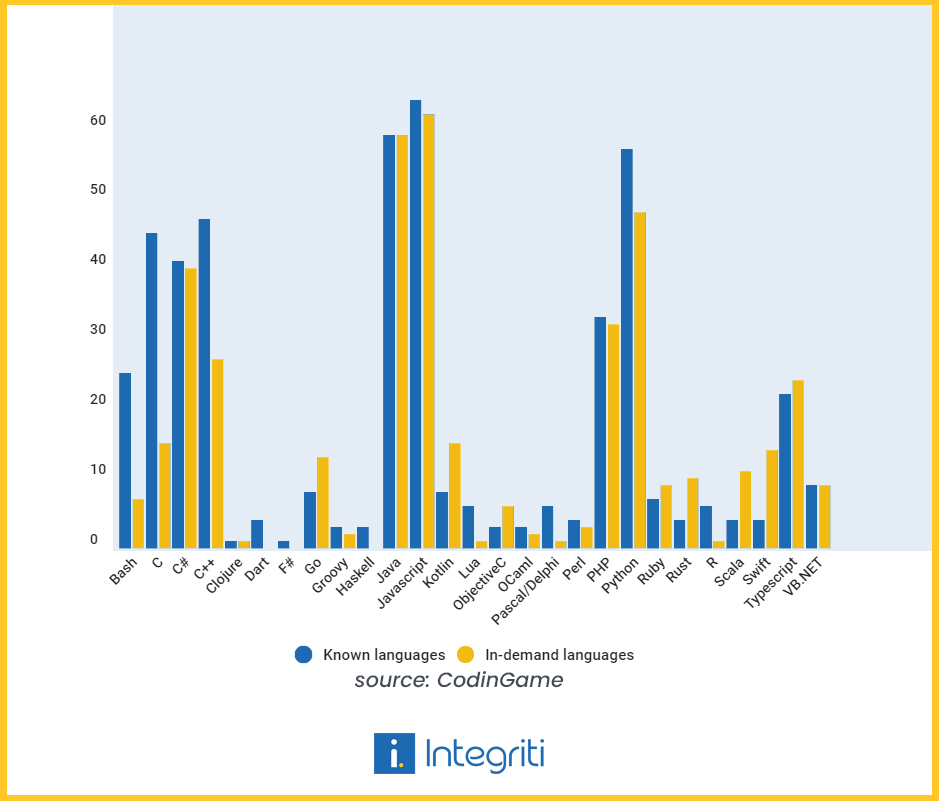
    A recent survey by CodinGame sheds light on the popularity of programming languages and their demand by employers. According to the results, more than half of the programmers knew how to code in JavaScript, Java, and Python. These three continue to be the most widely used programming languages in the world.

    A survey about most in demand programming languages

    On the demand side, results showed that close to 60% of the tech recruiters were on the lookout for professionals working with JavaScript and Java. These findings signal that the programmers and employers are in sync at least when it comes to these two languages. However, the same cannot be said for other languages like C, Python, etc. The demand for these languages is less than their popularity among programmers. For example, 57% of developers code in Python, but only 48% of companies need Python development. This gap is even bigger for C. 45.1% of programmers code in C however only 15.4% of companies require C development.

    These insights highlight how most tech companies favor 4 programming languages: JavaScript, Java, Python, and C#. In our opinion, it’s better to stick with JavaScript as it’s the most popular programming language for a reason. As a matter of fact, JavaScript development also made it to our list of Top Ten Tech skills in Canada for 2021! Most companies developing web UIs need to interface with JavaScript. Moreover, with the introduction of NodeJS, it’s also being used to develop server-side applications as well. If you want to learn a lesser-known language to stand out, then consider TypeScript. This past October, TypeScript was named among the fastest-growing languages in GitHub’s Octoverse Report. The results also showed a small shortage for this language as 24% of companies needed TypeScript development but only 22% of developers knew it.

    The survey overall highlights the dominance of few major programming languages like Java, JavaScript, and Python. The results also suggest a surplus of developers dealing with Python and C. For these developers, it would be better to switch to other languages to improve their job prospects in this competitive environment.

  • Press Release: Integriti Group Rebrands

    On 17 Oct 2022, we are happy to announce to you the launch of the new Integriti logo and website as part of the ongoing evolution of our company’s brand.

    The main image of Integriti Group unveils a brand new look blog post

    ‍

    Following the breakout growth of our digital marketing and software development services over the past year, our team has been busy updating our visual identity to reflect our new capabilities and the vision of engineering growth for our clients.

    We believe that in today’s globally interconnected world and with the rise of digital transformation, enterprises need smart technology solutions to achieve operational efficiency, business growth, and competitive disruption. Not only do they require flexible solutions but also visionary partners like Integriti that can speak their language.

    Today, we’re proud to be a trusted partner of leading organizations and to have delivered successful outcomes in a variety of projects ranging from designing an enterprise knowledge-sharing system to developing a large e-commerce platform. Complementing our industry-leading software development expertise, we provide UX/UI design and content marketing through our high-performing and results-driven marketing team, also known as “Magnetic Marketing”.

    With Integriti embarking on a new journey and providing more exciting solutions, we believe this is the right time to create a new brand look that allows us to tell our multi-service story better. We also want our brand to be reflective of our promise of seamless communication, real collaboration, and cultural alignment with our clients.

    The New Integriti Has Arrived.

    Our challenge was to honor Integriti’s identity while making the new branding reflective of the company’s growth. We have retained the “i” in Integriti from the older logo and have created a more vibrant, bold, and modern design. Without going far from the old identity, our new logo successfully communicates our growth-oriented spirit and our varied range of services.

    Brand Elements

    “i” for Integriti

    Our brand mark, the “i” in Integriti represents order, trust, and stability which is why it is the center of attention in the logo design. Itis reflective of not only the integrity with which we serve our clients but also embodies our penchant for innovation.

    Color Palette and Gradient

    A gradient represents a direction of maximum change. We have used colour gradient comprising of blue and purple to reflect our two major services of Software development and Digital marketing respectively.

    Font Changes

    We wanted our font choice to be more dynamic, bold, and modern. Without straining too far away from the old identity, we have selected a more symmetrical Sans Serif font to blend in with our overall branding.

    Revamping our website

    We have also revamped our website according to the new brand identity and are continuously working to improve the user experience. The new site offers informative content on our services in a more clean and organized layout to ensure a positive user journey. The new brand identity and website are designed to further elevate Integriti as we continue to provide leading-edge digital solutions for our current and upcoming customers.

  • Secrets of performance-oriented frontend development

    When a web page takes longer than three seconds to load, 40% of visitors leave, increasing the bounce rate.

    Similarly, a slow mobile app would also have poor performance and irritate consumers. After a few tries, the customer will remove your application and download a more user-friendly one.

    The ease of use and user-friendliness of your specific digital solution have a direct impact on the performance of the app. If compromised, it degrades the user experience and lessens the likelihood that users will engage frequently or stay connected to the app or website over time.

    On the other hand, developing a web or mobile app with front-end performance in mind increases the chance that your product will succeed. As a result, your priority should be to create an app or website that loads quickly, is SEO-friendly, performs well, and is well-designed.

    Here are a few secrets that can help you build up your performance-oriented front-end development.

    Optimize Images & Use WebP

    Images are a crucial component of web pages. Considering they increase user engagement, 93.7% of websites on the internet employ at least one image file format.

    The drawback of using images is that, unless they are optimized, they have a negative impact on the front-end loading time. However, there are various approaches to optimizing images:

    Use AVIF or WebP

    Compared to previous formats like JPEG and PNG, using modern image formats like WebP and AVIF shows better performance. When compared to JPEG and PNG, WebP is between 25% and 35% smaller. AVIF is 20% and 50% smaller than WebP and JPEG, respectively.

    The browser support is the drawback, though. WebP acquired browser support only recently, so older versions may not support it. In contrast, Chrome and Opera are the only browsers that support AVIF. As a result, you must utilize the <picture> element in native HTML with fallback support.

    Serve images of the right dimensions.

    Using responsive images is another approach to speed up a website’s performance and cut down on image delivery time. Mobile and tablet devices account for more than 50% of all traffic. The frontend loading time could be further reduced by scaling the image to popular device dimensions and serving it using a srcset.

    There are numerous other methods you can use to speed up the frontend loading time through image optimization in addition to picking the right format and dimensions. Additional recommended best practices are:

    • Use of progressive JPEGs.
    • Use of HTTP/2 instead of HTTP/1.1.
    • Use of image sets.
    • Image Compression
    • Serve smaller images to users on slow connections.

    Compress Files & Use CDNs

    Building a lightweight front end for your web or mobile solution is made much easier with the use of content delivery networks, or CDNs. These web directories have a successful global network. Your app will load more quickly if you use files hosted on CDNs since you can use the cached versions of the files from the closest servers. It enables you to quickly serve more users while preventing bottlenecks.

    Compressing the files to be used comes next after using common files from CDNs. Every file, including documents, images (JPEG, PNG), videos, audio clips, and presentations, can be compressed to enhance the functionality of your application. There are many compression tools available on the market that might be deployed for this.

    Once you’ve completed these two steps, your website or application will be much more responsive to consumer inquiries.

    Bundle & Minify Assets

    Two different performance improvements you may use in a web app are bundling and minification. By minimizing the amount of the requested static assets and decreasing the number of server requests, bundling and minification combined enhance performance.

    Multiple files are combined into one file by bundling. The quantity of server requests required to render an online asset, such as a web page, is decreased via bundling. Numerous unique bundles made expressly for CSS, JavaScript, etc. are possible. Having fewer files means that the browser will make fewer HTTP requests to the server or to the service that hosts your application. As a result, first-page performance is enhanced.

    Code that has undergone minification has unnecessary characters removed without affecting functionality. As a result, the size of the requested assets is significantly reduced (such as CSS, images, and JavaScript files). One of the most frequent side effects of minification is the reduction of variable names to one character, as well as the removal of comments and extraneous whitespace.

    Bundling and minification mainly speed up the first page request load time. After a web page has been requested, the web browser caches the static assets (JavaScript, CSS, and images). Therefore, bundling and minification don’t enhance performance when the same page, or pages, on the same site, are requested with the same assets. If bundling and minification aren’t used and the expires header isn’t set correctly on the assets, then the browser’s freshness heuristics mark the assets stale after some days. The browser also requires a validation request for each asset. Bundling and minification in this situation increase performance even after the initial page request.

    Use Caching and prefetching

    Pre-fetching and caching are two essential tools for front-end web performance. Pre-fetching involves pre-loading resources such as images, scripts, and stylesheets so that they can be delivered to the user more quickly. Caching, on the other hand, involves storing assets on the user’s device so that they don’t have to be requested from the server every time the user visits the site.

    Both of these techniques have a huge impact on website performance and user experience. By pre-loading resources and caching assets, sites can load faster and be more responsive, leading to improved performance and better user experience. Additionally, pre-fetching and caching can reduce the burden on the server, which can help to keep costs down and make sites more resilient.

    So if you want to improve your site’s performance and user experience, be sure to take advantage of pre-fetching and caching.

    Reduce The Number Of Server Calls.

    Generally speaking, the more requests your front end sends to the server, the longer it takes to load. This is due to the fact that sending any request to the server demands full communication before the page can be rendered. There are several approaches you may take to cut down on the number of server requests required to load the website.

    One of the simplest ways to cut down on server calls is to use CSS Sprites. Sprite loads a single image file combined using a collection of images rather than ten separate images to the site. The background image and background-position CSS properties can be used to display the desired image segment. By doing this, you’re minimizing the number of server requests necessary.

    Reducing third-party plugins is also important as they make up a large number of external requests and cutting down on them will boost your application’s loading speed. Preventing broken links to files that don’t exist can also help.

    You might also consider server-side rendering to accelerate the application’s initial load time.

    Making the initial move is never easy. The future, however, belongs to those who aren’t scared to innovate and redefine conventional approaches. You can ensure that your website loads quickly and offers a positive user experience by using these web performance optimization approaches. Just be sure to keep everything simple, smart, and seamless. And keep in mind that you only have 15 seconds to make an impact!

    First impressions of apps and websites are based on their user interface (UI) and front-end. The ease of use, seamless navigation, and fast loading are just a few of the elements that determine whether a user will use your digital product again. Therefore, it’s crucial to consider a web solution’s performance efficiency, whether it’s an App or an e-commerce website. You will be able to do so by using the advice we’ve provided above.

    ‍

  • Serverless Architecture

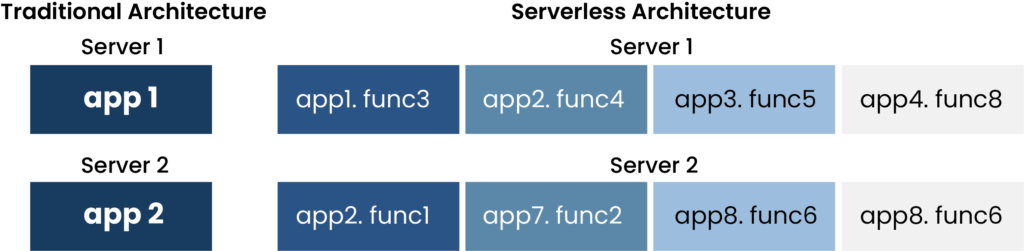
    Serverless computing, also referred to as simply Serverless, is a famed topic of the software architecture world. The biggest cloud-providing platforms like Amazon, Google and Microsoft are continuing to invest heavily and research on this type of architecture. Serverless is a cloud computing code execution model where a certain cloud provider takes over responsibility for servers running along with computing resources management. To put it in a simple view, there are no physical or virtual servers to manage, because they are automatically deployed in the cloud by the third-party vendors. Some of the famous serverless providers are AWS Lambda, GCP Functions and Azure Functions.

    The main difference between the traditional and serverless architecture can be schematically seen in diagram 1.

    A diagram which shows the Traditional vs serverless architecture.
    Diagram 1: Traditional Vs. Serverless

    Components of the serverless application are:

    Functions

    Functions are what imply business and application logic. They execute code for certain actions. There can be multiple functions working as a composite function. Sometimes they may be triggered or self-initiated when a condition is met. This process is hidden from the user. The user creates a program code, specifies needed dependencies and uploads it. The provider then provides the computing environment.

    Backends

    This unit allows the development to shift backend regular functions from data storage to the cloud, managing latency of the architecture and dependencies deepening. It also aids with functionalities like Simple Notification Service (SNS), Simple Queue Service (SQS), kinesis for streaming data, data warehouse queries, batch data cloud dataflow and event grids.  

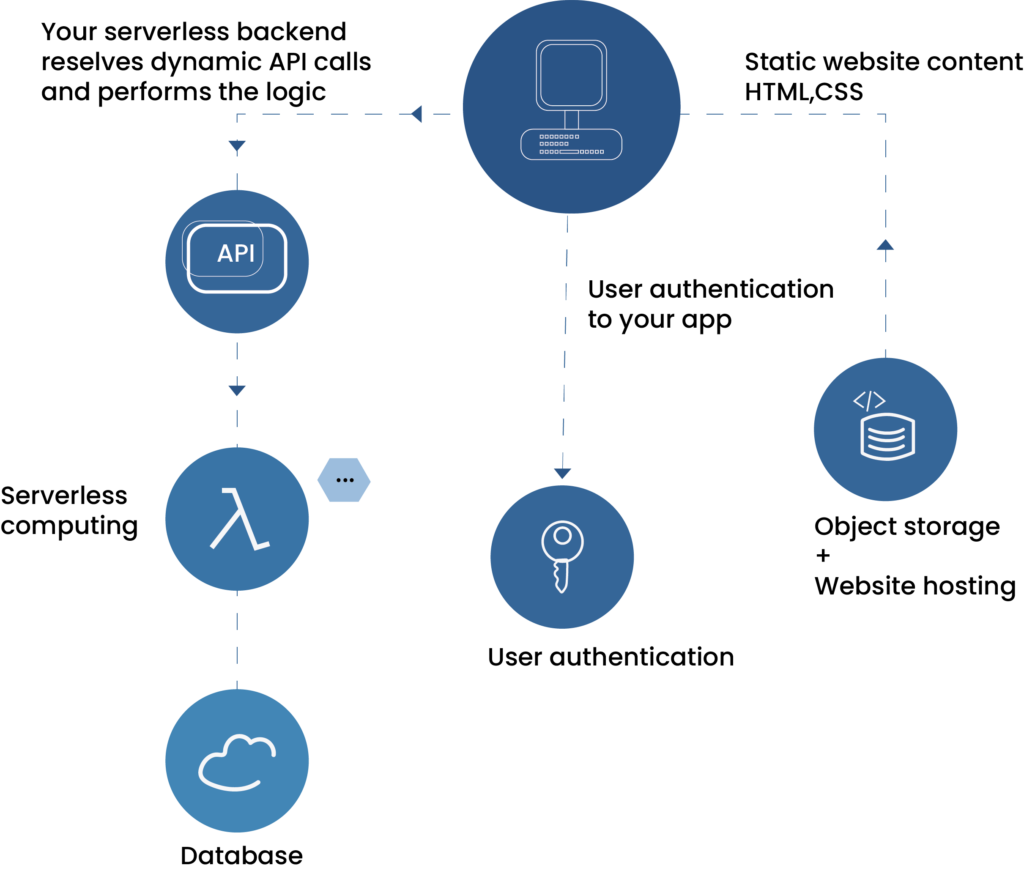
    Here is how a serverless setup looks like.

    Image shows serverless states
    Diagram 2: Serverless State

    When we talk about Serverless, it is primarily defined by two different but overlapping areas: “Backend as a Service” (BaaS) and “Function as a Service” (FaaS). BaaS and FaaS are related in their operational attributes and are frequently used together. Let’s find out what each of these scopes encompasses.

    BaaS

    This term is used to describe applications that significantly or fully incorporate third-party, cloud hosted applications and services to manage server-side logic and state. These are typically rich client applications like single page web apps or mobile apps that use the vast ecosystem of cloud accessible databases (e.g., Firebase), authentication services (AWS Cognito) and so on.

    FaaS

    This term is used to describe applications where server-side logic is written by developer but unlike mainstream architectures, its run-in stateless computer containers are event-triggered, ephemeral and managed by a third party. Containers specify OS and software configurations. Regarding uptime, the container keeps working until the current job is executed and destroyed. It can host any microservice and app and there are no timeout restrictions.

    Faas, replaces the click-processing physical server with something that does not need a provisional server nor a related app. The only code that needs to change when moving to FaaS is the main method, also called startup code. Handlers which manage message listener interfaces are also changed in the method signature.

    Deployment is very different from traditional systems. The code is uploaded to the FaaS provider and then the provider instantiates VM’s and manager process. Horizontal scaling is completely automatic, elastic and managed by the provider. If the system needs to process a hundred requests in parallel, computer containers come into play. They execute the functions and are created and destroyed purely driven by runtime need. Functions in FaaS are typically triggered by event types defined by the provider. Such event types include S3 (file/object) updates and Kinesis. They may also be triggered as a response to inbound HTTP requests via API gateway. However, this is an uncommon use of configuration from within the same cloud environment.

    When working in an instance-bound state or a machine state, there may be some restrictions posing to FaaS. Like data that is stored in variables or local disk. Such storage is available but there is no guarantee that such a state persists across multiple invocations and more strongly there should be no assumption made that state from one invocation of a function will be available to another invocation of the same function. This is the reason why FaaS are often described as stateless. But this may not a correct techical assessment. Rather it is appropriate to say that any state of a FaaS function that is required to be persistent needs to be externalized outside of the FaaS function instance. Any function will typically make use of a database, a cross app cache like Redis or a network file/object store to store state across requests or to provide further input necessary to handle a request.  

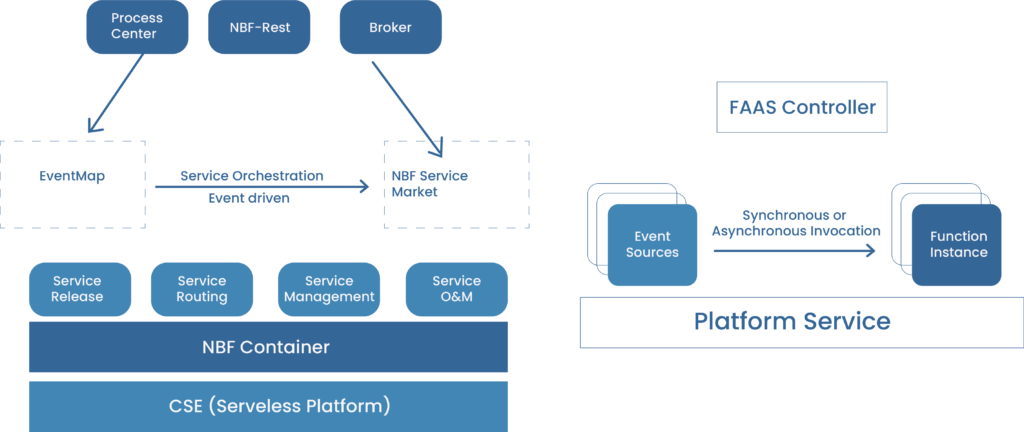
    New-retail business framework (NBF) is an open framework developed by the supply chain infrastructure technology team for new retail services. A serverless system like FaaS helps NBF achieve industry standard practices, load balancing and long-term sustainability. Diagram 3 shows how NBF works in conjunction with FaaS.

    Image about NBF-FaaS Architecture
    Diagram 3: NBF-FaaS Architecture

    Event Sources Function is an event driven set. Function Instances provide functions or microservices. The FaaS Controller manages function control services such as API Gateway or Backend for Front (BFF). Platform Service Functions relay on platform services such as privilege management API’s and OSS. Cloud Service Engine (CSE) provides dynamic scaling capabilities which rapidly adapt to different resources needs during on and off-peak hours. CSE optimizes container cold, hot start performance and serverless O&M tools such as logging, monitoring and link tracking. NBF containers use Open Service Gateway Initiative (OSGI) architecture and provide complete bundle lifecycle management, including load, start, unmount and delete as well as isolation and communication. The whole platform capabilities result in services release which allows for quick release of a function or to bundle as a service, service routing which includes polymorphism, degradation and moke routing, service management with service vision control and service start/stop and lastly the service O&M for serverless services, hybrid deployment, phased release, disaster recovery.

    Lastly the important concept to grasp is bundle communication. Bundles are able to utilize container capabilities such as Spring context hosting and AOP by using the import mechanism provided by containers. For example:

                  org.springframework       org.apache.commons.logging         org.aopalliance       org.aspectj    

    ‍
    The NBF containers create an independent sandbox for each bundle which ensures code level bundle isolation from time of loading thus preventing class and resource conflicts among bundles. They manage bundle context globally and provide plug-in hosting. This sums up how FaaS works and conjoins.

  • 10 most common JavaScript issues you need to look out for

    JavaScript is a powerful and popular programming language used to create dynamic and interactive websites. It’s nothing new to have robust JavaScript-based libraries and frameworks for developing single-page applications (SPAs), graphics and animation, and server-side JavaScript platforms. JavaScript is now fully commonplace in the realm of web app development, making it a crucial ability to know.

    As with any programming language, there are several issues that development teams encounter when using JavaScript. From creating memory leaks to confusion about equality, developers must be aware of these common issues and how to resolve them.

    In this article, we’ll discuss 10 of the most common JavaScript issues that businesses face and how to resolve them. By understanding and addressing these issues, your development team can create more efficient and reliable code.

    So, let’s get started!

    Creating Memory Leaks

    Memory leaks occur when you allocate memory for an object or variable but do not free it when it is no longer required. This can cause your application to use more memory than it needs and can lead to performance issues. To prevent this, development teams need to be aware of the types of objects and variables they are using and ensure they are properly freed when they are no longer needed.

    When creating memory leaks, developers should keep in mind the lifespan of the objects and variables they are working with. If an object or variable is not needed anymore, developers should make sure to free the associated memory as soon as possible. Furthermore, developers need to be aware of any external libraries or frameworks they are using and make sure to properly dispose of any objects or variables associated with them.

    Thinking There Is Block-level Scope

    One of the most common issues developers face is thinking that there is block-level scope in JavaScript. The block-level scope is the concept that variables declared within a certain block of code are only accessible within that block. This is not the case in JavaScript, as variables are scoped to the function, and they are declared in. This can lead to confusion and unexpected behaviour when working with variables.

    To avoid this issue, developers should be aware of the scope of variables they are working with. In addition, developers should make use of the let keyword to ensure that variables are only accessible within the block they are declared in. This will help to avoid confusion and unexpected behaviour when working with variables.

    Incorporating Helpful Error Handling into JavaScript Code

    Error handling is an important part of any software application. Unfortunately, it is often overlooked or neglected when it comes to JavaScript code. Error handling is essential for ensuring that your application is stable and reliable. It can help to catch and fix errors before they become a problem.

    When incorporating error handling into your JavaScript code, it is important to make use of the try/catch statement. This statement will allow you to catch any errors that occur in your code and handle them accordingly. Furthermore, you should make use of the console.error() method to log any errors that occur. This will help to ensure that any errors that occur in your application are properly handled and logged.

    Setting a Breakpoint and Examining Data with Firebug

    Firebug is a powerful debugging tool for JavaScript code. It allows developers to set breakpoints in their code and examine the data associated with it. This can be extremely useful for understanding how your code is working and can help to identify and fix errors quickly.

    When using Firebug to debug your JavaScript code, it is important to understand the different types of breakpoints that can be set. There are line breakpoints, which will pause the code execution at a particular line of code, and conditional breakpoints, which will pause the code execution when a certain condition is met. It is also important to understand the data that can be examined with Firebug. This includes variables, functions, and objects.

    Failure to Use “Strict Mode”

    Strict mode is a feature of JavaScript that helps to enforce better coding practices. It helps to eliminate certain types of errors and can lead to more reliable code. Unfortunately, many developers do not make use of this feature and as a result, their code may be more prone to errors.

    To make use of strict mode, developers need to add the “use strict” directive at the beginning of their JavaScript code. This will enable strict mode and help to ensure that their code is more reliable. Furthermore, developers should make use of the “strict” keyword when creating functions and classes. This will ensure that any errors that occur in these functions or classes are caught and handled properly.

    Providing a String as the First Argument to setTimeout or setInterval

    setTimeout and setInterval are two of the most used methods in JavaScript. They allow developers to schedule tasks to be performed later. One of the most common issues developers face when using these methods is providing a string as the first argument instead of a function. This can lead to unexpected behaviour or errors in your code.

    To avoid this issue, you should always make sure to provide a function as the first argument to setTimeout and setInterval. If the function needs to be executed at a later time, developers should make sure to wrap it in an anonymous function. This will ensure that the function is executed at the correct time and with the correct parameters.

    Creating Incorrect References to Instance Methods

    When creating object-oriented applications in JavaScript, developers need to be aware of the instances of objects they are working with. One common issue developers face is creating incorrect references to instance methods. This can lead to unexpected behaviour or errors in your code.

    To avoid this issue, developers should make sure to use the “this” keyword when referencing instance methods. This will ensure that the correct instance of the object is being used. Furthermore, developers should make use of the bind() method to bind the context of a function to a specific instance of an object. This will help to ensure that the correct instance is being referenced when the function is called.

    Failure to Properly Leverage Prototypal Inheritance

    Prototypal inheritance is a powerful feature of JavaScript that allows developers to extend an object’s functionality. Unfortunately, many developers do not take advantage of this feature and as a result, their code can be less efficient and less reliable.

    To take advantage of prototypal inheritance, developers should make use of the prototype keyword when creating objects. This will allow them to create objects that inherit the properties and methods of other objects. Furthermore, developers should make use of the extend() method to easily extend the functionality of an existing object. This will help to ensure that their code is more efficient and reliable.

    Inefficient DOM Manipulation

    DOM manipulation is an essential part of any JavaScript application. Unfortunately, many developers do not take the time to optimize their DOM manipulation code and as a result, their applications can be slow and inefficient.

    To optimize the DOM manipulation code, developers should make use of the querySelector() and querySelectorAll() methods. These methods will allow developers to select elements quickly and efficiently from the DOM. Furthermore, developers should make use of the createElement() and appendChild() methods to create and add elements to the DOM. This will help to ensure that their DOM manipulation code is fast and efficient.

    Confusion About Equality

    Equality is an important concept in any programming language. Unfortunately, many developers are confused about the different types of equality in JavaScript and as a result, their code can be unreliable.

    In JavaScript, there are two types of equality: strict equality (===) and loose equality (==). Strict equality checks for both the value and the type of a variable, while loose equality only checks for the value. To avoid confusion, developers should always make use of strict equality when comparing two variables. This will help to ensure that their code is more reliable.

    In this blog post, we looked at 10 common JavaScript issues that developers face. From creating memory leaks to confusion about equality, these issues can lead to unexpected behaviour or errors in your code. To avoid these issues, developers should make sure to understand the different types of errors in JavaScript and make use of the tools and features available to them. By doing so, they can ensure that their code is more reliable and efficient.

    ‍

  • Bridging the Expertise Gap: Staff Augmentation’s Key Role in Digital Transformation

    Bridging the Expertise Gap: Staff Augmentation’s Key Role in Digital Transformation

    ‍Bridging the Expertise Gap: Staff Augmentation’s Key Role in Digital Transformation

    ‍

    The digitaltransformation era has ushered in a wave of unprecedented technologicaladvancements, changing the way businesses operate, interact with customers, andmake strategic decisions. To stay competitive and relevant in today’sfast-paced business landscape, organizations must embrace digitaltransformation. However, many companies face a significant challenge: theexpertise gap. This gap often arises due to the shortage of skilledprofessionals who can lead and implement digital initiatives.

    Staff augmentation isemerging as a crucial strategy to bridge this expertise gap and drivesuccessful digital transformation.

    Before we move on tothe essential role of staff augmentation in digital transformation, we need tounderstand this expertise gap.


    Understanding theExpertise Gap

    The expertise gap indigital transformation is a complex challenge that organizations face whentrying to adopt and integrate advanced technologies into their operations.

    Here are some keyreasons behind this gap:

    • RapidTechnological Advancements:Technology evolves at an exponential rate. Keeping up with the latest trends,tools, and platforms can be overwhelming for in-house teams.
    • Shortageof Skilled Talent: The demandfor tech-savvy professionals often exceeds the supply. Finding and retainingtop-tier talent in fields like AI, data science, cybersecurity, and cloudcomputing can be a daunting task.
    • BudgetConstraints: Hiring full-timeexperts in emerging technologies can be expensive. Many businesses may not havethe financial resources to maintain a dedicated team for every digitalinitiative.
    • ProjectSpecificity: Some digitaltransformation projects require specialized skills that might not be needed onan ongoing basis. In such cases, hiring full-time employees may not becost-effective.

    Bridging the Gapwith Staff Augmentation

    Staff augmentation is astrategic solution that involves hiring external experts or teams to workalongside your in-house staff on a temporary or project-specific basis.

    Here’s how staffaugmentation plays a pivotal role in digital transformation:

    • Accessto Specialized Skills: Staffaugmentation allows organizations to tap into a vast pool of specializedtalent. Whether you need data scientists, cloud architects, or cybersecurityexperts, you can quickly find the right professionals for your project.
    • Flexibility: Businesses can scale their workforce up or downbased on project requirements. This flexibility is particularly valuable fordigital transformation initiatives, where resource needs can fluctuate.
    • Cost-Efficiency: Instead of the high costs associated withhiring full-time employees, staff augmentation allows you to pay for theexpertise you need when you need it. This cost-effective approach cansignificantly reduce project expenses.
    • AcceleratedProject Delivery: By bringingin experts with the necessary skills and experience, organizations can expediteproject timelines. This acceleration is crucial in the competitive digitallandscape.
    • KnowledgeTransfer: Collaborating withexternal experts provides a unique opportunity for knowledge transfer. Yourin-house teams can learn from the experts, enhancing their skills andcapabilities.
    • RiskMitigation: Digitaltransformation projects often carry risks, such as technical challenges anddelays. Staff augmentation helps mitigate these risks by ensuring that theright talent is available to address any issues promptly. 

    Conclusion

    Digital transformationis no longer a choice but a necessity for businesses seeking long-term success.However, the expertise gap can pose a significant challenge. Staff augmentationemerges as a strategic solution, enabling organizations to harness specializedskills, maintain flexibility, control costs, and accelerate project delivery.By bridging the expertise gap with staff augmentation, businesses can embracedigital transformation with confidence, remain competitive, and pave the wayfor a more innovative future.