Category: integriti.io

  • The CIO’s Guide to AI Tokenomics: Controlling Cost at Scale

    The CIO’s Guide to AI Tokenomics: Controlling Cost at Scale


    For the last two years, the question CIOs faced about AI was whether it could work. That question is settled. The models are capable, the use cases are proven, and nearly every enterprise has something in production or close to it.

    As enterprises expand their AI development efforts and push autonomous AI agents into real workflows, the volume of model calls, and the cost behind them, is climbing faster than most budgets anticipated.

    A harder question has taken its place, and it’s the one that will separate the organizations that scale AI from the ones that quietly pull back: what does it actually cost, and what does it return?

    This is AI tokenomics. Every prompt, every query, every model call consumes tokens, and every token has a price. At pilot scale, nobody notices. A few hundred dollars a month is a rounding error. But AI usage doesn’t stay at pilot scale. It spreads across teams, embeds into workflows, and starts running thousands of times a day. Those invisible per-token costs compound into a number large enough to erase the value the AI was supposed to create. Plenty of CIOs are discovering this the hard way, in a cloud bill that arrived without warning.

    Controlling it isn’t about using less AI. It’s about governing the economics of AI the same way you’d govern any other major operating expense. That comes down to five disciplines.


    1. Visibility

    You cannot control what you cannot see. The first failure in AI cost management is that most organizations have no idea what their AI actually costs, broken down by team, by use case, or by workflow. The spend shows up as a single opaque line on a cloud invoice, impossible to question or optimize.

    Real visibility means tracking consumption at the level where decisions get made. Which workflows are the heaviest consumers. Which teams are driving spend. Which use cases cost more than they return. Without this, every other discipline is guesswork. With it, the expensive outliers become obvious, and they are almost always a small number of workflows quietly consuming a disproportionate share.

    2. Accountability

    Once you can see the spend, someone has to own it. In most enterprises, AI costs sit in a shared pool that belongs to no one, which means no one is motivated to control them. Spend that belongs to everyone gets managed by nobody.

    Accountability means assigning AI consumption to the teams and leaders who generate it, the same way you’d assign any budget. When a team sees its own AI spend and owns it, behavior changes. Workflows get optimized. Wasteful patterns get questioned. The goal isn’t to punish usage, it’s to make the cost of AI visible to the people in a position to manage it.


    3. Model Routing

    This is where the largest savings usually hide. The instinct, when AI matters, is to send every task to the most capable and most expensive model available. It works, but it’s the equivalent of hiring your most senior engineer to reset passwords.

    Most tasks don’t need the flagship. A simple classification, a short summary, a routine extraction, these can run on a smaller, cheaper, faster model with no loss in quality. Model routing means matching each workload to the right model by cost and capability, reserving the expensive models for the work that genuinely requires them. Done well, it can cut AI costs substantially without touching output quality. It is the single highest-leverage move in AI tokenomics, and the one most organizations haven’t made.

    This matters even more as autonomous AI agents enter production, since a single agent can chain dozens of model calls to complete one task, multiplying cost in ways a simple prompt never would.

    4. Value Proofing

    Cost is only half the equation. The point of governing tokenomics isn’t to spend as little as possible, it’s to ensure every dollar spent returns more than it consumes. A workflow that costs more to run than the value it produces should be caught and either fixed or retired.

    Value proofing means measuring return, not just spend. For each significant use case, what is it actually saving or generating against what it costs to run? This is how AI earns its place in the budget, and how a CIO defends that budget to the board. It’s also how you avoid the trap of impressive-looking AI that is quietly running at a loss.

    5. Skills Development

    All of this requires people who understand it. Tokenomics is a new discipline, and the teams running your AI need the skills to monitor consumption, route models intelligently, and reason about cost and value together. Without that capability in-house, cost control defaults to hope.

    Investing in these skills is what makes the other four disciplines sustainable. It turns cost management from a one-time cleanup into an ongoing capability that scales with your AI footprint.

    The shift this requires

    The uncomfortable truth is that most enterprises are still treating AI cost as an afterthought, a surprise to be dealt with when the bill arrives, rather than a system to be designed. That worked when AI was a pilot. It breaks the moment AI becomes infrastructure.

    The CIOs who scale AI successfully won’t be the ones who deployed the most or moved the fastest. They’ll be the ones who can account for every dollar their AI spends and every dollar it returns. Capability was the hard part of the last two years. Economics is the hard part of the next two.

    For enterprises investing in AI development services and AI integration across their systems, cost governance isn’t a constraint on ambition. It’s what makes ambition sustainable.

    AI that no one can account for doesn’t get scaled. It gets cut. The difference is whether you built the discipline to govern it before the bill forced the conversation.


  • Why Cultural Fit Matters More Than Ever in Hiring

    Why Cultural Fit Matters More Than Ever in Hiring

    Hiring the right person isn’t just about ticking off skills on a checklist. It’s about finding someone who believes in your mission, shares your values, and can thrive in your company’s environment. That’s where cultural fit comes in—and in 2025, it’s more important than ever.

    As companies continue to adopt flexible work models and build global teams, hiring someone who “fits in” isn’t just a nice-to-have—it’s essential for long-term success.

    What Is Cultural Fit?

    Cultural fit refers to how well a candidate’s values, beliefs, and working style align with your company’s culture. It’s about more than just personality—it’s about shared purpose and compatibility.

    If your company values collaboration, innovation, and ownership, then hiring someone who prefers solo work, fixed routines, and top-down management might cause friction—even if they’re highly skilled.

    Why It Matters in 2025

    The way we work has changed. Remote work, global teams, and shifting expectations have made cultural alignment even more critical. Here’s why cultural fit has become a major factor in successful hiring:

    • Higher Retention: Employees who feel connected to your culture are more likely to stay.
    • Better Performance: Teams with strong cultural alignment collaborate more easily and stay motivated.
    • Faster Onboarding: Culturally aligned employees adapt quicker and start contributing sooner.
    • Improved Morale: A good cultural match leads to less conflict and more cohesion across teams.

    Skills vs. Culture: It’s Not Either/Or

    Some companies fear that prioritizing culture might lead to hiring the wrong person just because “they’re nice.” But hiring for culture doesn’t mean ignoring skills. It means finding someone who has the right skills and can thrive in your environment.

    In fact, the best hires are both technically qualified and culturally aligned.

    A good hire in 2025 should have:

    • The required skill set or potential to grow into the role
    • Alignment with the company’s mission, values, and work style
    • The ability to work effectively with your existing team
    • Adaptability to your specific business and communication style

    Red Flags of a Poor Cultural Fit

    Even the most experienced candidates can be a poor match if they’re not aligned with your company’s ways of working.

    Watch out for these signs:

    • They speak negatively about past team experiences or collaboration
    • They value job titles more than learning or growth
    • They prefer rigid routines in a fast-moving, flexible company
    • They show resistance to feedback or working in a team setting
    • They don’t ask questions about your company culture during the interview

    Sometimes, the lack of interest in how your team works is a clear sign they may not be invested for the long haul.

    How to Assess Cultural Fit During Hiring

    Cultural fit isn’t always obvious from a résumé. That’s why you need a thoughtful hiring process that goes beyond the surface.

    Here are a few ways to do it:

    1. Ask the Right Questions

    Go beyond technical interviews. Include behavioral and situational questions like:

    • “What type of team do you work best in?”
    • “Tell us about a time you had to adapt to a new culture or work environment.”
    • “How do you handle feedback and communication on remote teams?”

    2. Share Your Company Culture Clearly

    Make your company values, expectations, and working style visible during the hiring process. A culture deck, short video, or real employee stories can help candidates self-assess if they’re a good match.

    3. Involve Multiple Team Members

    Let candidates meet future coworkers or other departments. This gives a more complete picture and helps both sides evaluate chemistry and collaboration styles.

    4. Use Culture-Focused Assessments

    Some companies use personality or values assessments—not to reject candidates, but to guide better team alignment and onboarding.

    Cultural Add vs. Cultural Fit

    It’s important to note that cultural fit doesn’t mean hiring people who all think or look the same. That can lead to groupthink or a lack of innovation.

    Instead, aim for “culture add.” This means hiring people who share your values but bring different perspectives and experiences to the table.

    A culture add can:

    • Challenge existing assumptions
    • Contribute to innovation
    • Make your team more inclusive and dynamic
    • Bring in fresh problem-solving approaches

    This balance between alignment and diversity is the sweet spot for strong teams.

    The Cost of Ignoring Cultural Fit

    Hiring someone who doesn’t align with your culture can lead to:

    • Early resignations or quiet quitting
    • Conflict with other team members
    • Low morale across departments
    • Loss of time, money, and training investment

    The cost of a bad hire can go well beyond salary. It impacts team energy, customer satisfaction, and your employer brand.

    Final Thoughts

    In today’s hiring environment, cultural fit isn’t a bonus—it’s a must. When you bring people into your team who understand your mission, share your values, and fit your work style, you’re not just filling a role. You’re building a team that’s stronger, more connected, and more productive.

    So next time you’re hiring, take a step back and ask:
    “Will this person succeed here—not just on paper, but in our world?”

    That answer could make all the difference.

  • What Is RPO and Why Is It the Future of Scalable Hiring?

    What Is RPO and Why Is It the Future of Scalable Hiring?

    Hiring today looks very different than it did a few years ago. With the rise of remote work, global teams, and talent shortages, companies are under pressure to hire faster and smarter. That’s where Recruitment Process Outsourcing (RPO) comes in.

    Whether you’re a fast-growing startup or an enterprise scaling operations globally, RPO can offer the flexibility, efficiency, and expertise your business needs to stay ahead.

    In this blog, we’ll break down what RPO really is, how it works, and why it’s becoming the go-to hiring solution for modern companies.

    What Is RPO?

    RPO stands for Recruitment Process Outsourcing. It’s a hiring model where a company outsources all or part of its recruitment process to an external partner.

    Unlike traditional staffing agencies that fill individual roles, RPO providers take over your entire hiring strategy—from sourcing and screening to interviews, onboarding, and even employer branding.

    RPO is not just a service. It’s a partnership.

    How RPO Works

    When you work with an RPO provider, you’re getting a dedicated recruitment team that works as an extension of your company. This team gets to know your culture, your goals, and your hiring needs—then builds a process that’s completely tailored to you.

    RPO providers typically handle:

    • Creating or refining job descriptions
    • Sourcing candidates across multiple platforms
    • Screening and initial interviews
    • Background checks and reference calls
    • Offer management and negotiation
    • Onboarding support
    • Recruitment data and reporting
    • Employer brand strategy

    You can choose full RPO (for all hiring needs) or project-based RPO (for specific roles or timelines). There’s also hybrid RPO, which mixes in-house hiring with outsourced support.

    Why RPO Is Gaining Popularity

    The business world is changing fast. Companies need talent strategies that are just as flexible and forward-thinking. Here’s why RPO is becoming the future of scalable hiring:

    1. Faster Time to Hire

    Open roles cost money. Every day without a hire slows down your business. RPO providers already have pipelines, platforms, and expertise to move fast.

    • Reduced time spent sourcing
    • Faster screening and interviews
    • Ready access to pre-vetted talent
    • Streamlined hiring steps

    In many cases, RPO partners can fill roles in a fraction of the time it takes internal teams.

    2. Access to Better Talent

    With an RPO provider, you’re not limited to who applies to your job post. These partners proactively reach out to passive candidates, niche professionals, and global talent pools.

    • More diverse, qualified applicants
    • Candidates with strong cultural alignment
    • Better chances of long-term retention
    • Reduced risk of bad hires

    This focus on quality over quantity means better hires—every time.

    3. Scalable and Flexible Hiring

    Whether you’re hiring five people or fifty, RPO scales with your business. That makes it ideal for fast-growing startups, seasonal hiring, or large expansion projects.

    • Easily ramp up or slow down hiring
    • No need to constantly build internal recruiting teams
    • Predictable hiring costs

    This flexibility makes RPO a smart solution for companies with evolving needs.

    4. Cost Savings

    Hiring in-house can be expensive—recruiters, tools, job ads, software, and training add up. RPO reduces these costs by consolidating them into one predictable service fee

    • Lower cost per hire
    • Less overhead and admin burden
    • Avoids hidden expenses from poor hiring

    Many businesses report saving 30–70% on hiring costs after switching to an RPO model.

    5. Improved Candidate Experience

    In a competitive market, your candidate experience matters. RPO teams focus on communication, professionalism, and speed—so candidates feel respected and informed at every stage.

    • Clear updates and timelines
    • Personalized communication
    • Smooth transitions from interview to offer
    • Stronger employer brand

    Happy candidates—even those who don’t get hired—can become future applicants or brand ambassadors.

    RPO vs Traditional Staffing: What’s the Difference?

    While both models support hiring, they’re built for different goals.

    __wf_reserved_inherit

    RPO is ideal for companies that want to build strong teams, not just fill seats.

    Is RPO Right for Your Business?

    You don’t need to be a giant company to benefit from RPO. In fact, many small and mid-sized businesses are now choosing RPO for its flexibility and efficiency.

    RPO might be right for you if:

    • You’re growing fast and need to scale hiring quickly
    • Your internal HR team is stretched too thin
    • You’ve struggled with poor hires or high turnover
    • You want to improve your hiring process and candidate experience
    • You’re hiring across locations or time zones
    • You need better data and reporting around hiring

    Final Thoughts

    Recruitment is no longer just about filling vacancies—it’s about building high-performing teams that drive growth. As hiring becomes more complex, competitive, and global, companies need smarter solutions.

    RPO is that solution.
    It combines strategy, speed, and expertise into one powerful model—designed to help you grow without the guesswork.

    If you’re ready to rethink hiring, save time, and tap into top talent, it might be time to explore Recruitment Process Outsourcing.

  • Top 5 Hiring Mistakes Companies Make—and How to Avoid Them

    Top 5 Hiring Mistakes Companies Make—and How to Avoid Them

    Hiring the right people is one of the most important things a business can do. The right hire can boost productivity, improve team morale, and help you grow faster. But the wrong hire? It can cost time, money, and even hurt your company culture.

    In today’s fast-moving job market, companies can’t afford to make the same old hiring mistakes. Let’s take a closer look at the top five hiring mistakes businesses still make—and more importantly, how to avoid them.

    Mistake #1: Rushing the Hiring Process

    In a rush to fill a role quickly, many companies end up hiring the first “okay” candidate who checks a few boxes. While speed is important, hiring too fast often leads to poor long-term results.

    Why it’s a problem:

    • You may overlook better candidates
    • You don’t get enough time to properly evaluate fit
    • You might end up rehiring for the same role within months

    How to avoid it:

    • Create a clear, structured hiring process with timelines
    • Take time to screen and interview multiple candidates
    • Involve more than one person in the decision-making
    • Plan ahead so you’re not hiring reactively

    The goal is to hire well, not just quickly.

    Mistake #2: Focusing Only on Skills, Not Cultural Fit

    A candidate may look perfect on paper, but that doesn’t mean they’ll thrive in your team. Many companies focus solely on technical skills and ignore whether the person will actually fit into the culture.

    Signs of poor cultural fit:

    • Misalignment with your company values
    • Struggles to work with the team
    • Low engagement or interest in the role
    • Resistance to your work style (e.g., remote, fast-paced, or collaborative)

    How to avoid it:

    • Include behavioral and cultural questions in interviews
    • Let the candidate meet team members or shadow a meeting
    • Talk openly about your company culture during the hiring process
    • Ask: “Would this person thrive here?”

    Hiring someone who aligns with your mission and work style is just as important as their qualifications.

    Mistake #3: Writing Vague or Unrealistic Job Descriptions

    Job descriptions are your first impression—and often your first mistake. Many businesses post vague, outdated, or unrealistic descriptions that confuse or turn off the right candidates.

    Common issues:

    • Too generic or full of jargon
    • A laundry list of skills and tasks that don’t reflect the actual role
    • No mention of company culture, growth opportunities, or values
    • Lack of clarity on what success in the role looks like

    How to avoid it:

    • Write clear, honest, and engaging job descriptions
    • Focus on outcomes—what will the person actually do and achieve?
    • Highlight your company’s culture, benefits, and values
    • Limit “must-haves” to actual requirements

    A good job description attracts the right people and sets clear expectations from day one.

    Mistake #4: Not Having a Structured Interview Process

    Winging interviews may work in movies—but not in real life. Unstructured interviews often lead to biased decisions, missed red flags, and hiring mistakes.

    Risks of unstructured interviews:

    • Inconsistent candidate experience
    • Difficulty comparing candidates fairly
    • Over-reliance on gut feelings
    • Missed opportunities to assess key skills or behaviors

    How to avoid it:

    • Use a structured interview format with predefined questions
    • Align questions with the role and your company’s values
    • Include both technical and behavioral assessments
    • Train your interviewers to evaluate objectively

    Structure helps remove bias and makes your hiring process more fair and effective.

    Mistake #5: Ignoring the Candidate Experience

    Even if you don’t hire someone, their experience still matters. Poor communication, long delays, or impersonal interviews can damage your employer brand—and cause top candidates to walk away.

    Poor candidate experience includes:

    • Long gaps between interview stages
    • No follow-up or feedback after interviews
    • Confusing or disorganized processes
    • Not showing respect for the candidate’s time

    How to avoid it:

    • Communicate clearly and consistently throughout the process
    • Set expectations about timelines and next steps
    • Provide feedback, even if it’s a “no”
    • Treat candidates like people, not just applications

    A great candidate experience builds trust and can lead to future referrals—even from people you don’t hire.

    Final Thoughts

    Hiring mistakes happen—but they’re avoidable. In today’s competitive market, companies that hire with intention, clarity, and care will always come out ahead.

    To recap, here are the top 5 mistakes to avoid:

    1. Rushing the hiring process
    2. Ignoring cultural fit
    3. Writing vague job descriptions
    4. Skipping a structured interview process
    5. Neglecting the candidate experience

    Hiring is more than just filling a seat—it’s about building a team that drives your business forward. Slow down, stay thoughtful, and make each hire count.

  • The Future of Recruitment: Trends Every Business Should Watch

    The Future of Recruitment: Trends Every Business Should Watch

    Recruitment isn’t what it used to be—and that’s a good thing. With changing work cultures, evolving technology, and shifting employee expectations, the way businesses hire is going through a major transformation.

    In 2025, staying ahead in recruitment means more than just posting job ads and screening résumés. Businesses that understand the new trends are the ones attracting the best talent—and keeping them. This blog explores the top recruitment trends every business should keep an eye on.

    Why the Recruitment Landscape Is Changing

    We’ve moved past the era of generic job portals and lengthy hiring processes. Today’s workforce is more diverse, digitally connected, and values-driven. Candidates are looking for more than just a paycheck—they want purpose, flexibility, and growth.

    At the same time, companies need to hire faster, smarter, and more efficiently in a competitive market.

    1. Remote Hiring Is Here to Stay

    The remote work revolution has changed hiring forever. Companies are no longer limited by geography. In fact, remote hiring opens access to global talent pools and helps businesses build more diverse teams.

    What this means for recruiters:

    • Interviews are now mostly virtual
    • Onboarding processes are remote-friendly
    • Time zones and asynchronous work need to be considered
    • Soft skills like communication and self-management matter more than ever

    To stay competitive, businesses must build remote-ready recruitment processes that prioritize clarity, culture, and collaboration.

    2. AI and Automation in Recruitment

    Artificial Intelligence (AI) is reshaping how companies find and filter candidates. While AI won’t replace recruiters, it can make their work faster and more accurate.

    How AI is being used in hiring:

    • Screening résumés and ranking candidates
    • Chatbots for candidate communication
    • Video interview tools that analyze tone, confidence, and communication
    • Predictive analytics to improve hiring decisions

    However, it’s important to keep the human touch. Automated tools should support recruiters—not replace them.

    3. Skills Over Degrees

    More companies are shifting their focus from education to skills. This is especially true in tech, design, and digital roles where portfolios and practical knowledge matter more than formal degrees.

    What to expect:

    • Job descriptions will prioritize skills and outcomes
    • Online certifications and bootcamps will gain more value
    • Tests, case studies, and project-based assessments will become more common
    • Micro-credentials (small, skill-based certificates) will become part of hiring criteria

    ‍

    Hiring for potential, adaptability, and soft skills is becoming just as important as hiring for experience.

    4. Employer Branding Matters

    In a world full of job options, candidates want to know what makes your company different. A strong employer brand can be the deciding factor for top talent.

    Ways to build a strong employer brand:

    • Showcase team stories and culture on your website and social media
    • Be transparent about company values, benefits, and growth opportunities
    • Improve the candidate experience—from first contact to onboarding
    • Collect and display testimonials from current employees

    Remember, your hiring process is a reflection of your brand. Make it memorable—for the right reasons.

    5. DE&I Will Drive Strategy

    Diversity, Equity, and Inclusion (DE&I) is no longer a checkbox—it’s a core business priority. Candidates care deeply about inclusive workplaces, and companies are being held accountable.

    How DE&I is shaping hiring:

    • Inclusive language in job descriptions
    • Blind résumé reviews to reduce bias
    • Structured interviews to ensure fairness
    • Outreach to underrepresented talent communities

    Investing in DE&I not only improves your team—it also enhances innovation, performance, and company reputation.

    6. Faster Hiring Through RPO and Staffing Partners

    The talent market is moving fast, and businesses need to respond quickly. That’s where Recruitment Process Outsourcing (RPO) and staffing partnerships come in.

    Companies are increasingly turning to expert partners to:

    • Reduce time-to-hire
    • Access larger talent pools
    • Scale hiring without straining internal teams
    • Improve quality of hire with pre-vetted candidates

    In 2025, outsourced hiring is no longer just for big companies—it’s a smart solution for businesses of all sizes.

    7. Data-Driven Decision Making

    Recruitment teams are becoming more analytical. Instead of relying on gut feeling, hiring decisions are now backed by data.

    Metrics that matter:

    • Time to fill
    • Cost per hire
    • Quality of hire
    • Source of hire
    • Candidate satisfaction scores

    ‍

    By tracking the right data, companies can continuously improve their recruitment strategy—and reduce costly hiring mistakes.

    8. Employee Referrals and Internal Mobility

    Referrals are still one of the best sources of quality hires. At the same time, companies are focusing more on growing talent from within.

    What this looks like:

    • Encouraging employee referrals with rewards
    • Promoting internal job opportunities
    • Upskilling current employees instead of hiring externally
    • Building career development paths to boost retention

    These approaches not only cut hiring costs but also build loyalty and boost morale.

    Final Thoughts

    The future of recruitment is fast, flexible, and human-centered. From remote hiring and AI to employer branding and diversity, businesses need to embrace change to attract and retain the best people.

    If you’re still relying on old-school methods, now is the time to evolve. The talent market is moving quickly—and the companies that adapt will lead the way.

    Whether you’re a growing startup or an established enterprise, keeping up with recruitment trends isn’t optional—it’s essential.

  • How to Build a High Performing Remote Team in 2025

    How to Build a High Performing Remote Team in 2025

    Remote work is no longer just a trend. It’s the new normal. As we step into 2025, businesses of all sizes are embracing remote teams to access global talent, reduce overheads and offer flexibility to employees. But building a successful remote team is more than just hiring people who work from home. It requires strategy, structure and the right tools.

    In this blog, we’ll walk you through the key steps to building a high-performing remote team in 2025—from hiring to culture to communication.

    Why Remote Teams Are the Future

    Remote work has changed how businesses think about productivity and team building. With better internet access, communication tools and flexible work policies, companies can now hire top talent from anywhere in the world.

    But flexibility doesn’t mean lower standards. In fact, the best remote teams are often more productive, more engaged and more efficient than traditional office teams. If built the right way.

    Step 1: Hire the Right People

    Hiring for a remote team isn’t the same as hiring for an in-office position. You need people who are self-motivated, good communicators and comfortable working independently.

    What to look for in a remote candidate:

    • Strong written and verbal communication skills
    • Self-discipline and time management
    • Experience with remote tools like Slack, Zoom, or Asana
    • Ability to work across different time zones
    • Problem-solving and decision-making skills without micromanagement

    Use structured interviews and practical tests to evaluate candidates’ remote-readiness. It’s also helpful to assess cultural fit and values, especially in a distributed setup.

    Step 2: Set Clear Expectations from Day One

    When team members are not in the same room, miscommunication can happen easily. That’s why clarity is key.

    Be clear about:

    • Working hours and availability
    • Project timelines and deadlines
    • Communication norms (e.g. when to use email vs chat)
    • Performance metrics and goals

    Create a remote employee handbook or onboarding guide. It helps new hires understand your processes and feel aligned with the team early on.

    Step 3: Use the Right Technology

    In 2025, remote work tools are smarter and more advanced than ever. Use them wisely to enable collaboration and track progress.

    Must-have tools for remote teams:

    • Communication: Slack, Microsoft Teams, Zoom
    • Project management: Trello, Asana, Monday.com
    • Document sharing: Google Workspace, Notion, Dropbox
    • Time tracking: Hubstaff, Clockify, Toggl
    • Feedback & engagement: Officevibe, 15Five, Lattice

    Make sure everyone on the team is trained on how to use these tools effectively. The goal is not to overload people with apps—but to make collaboration smooth.

    Step 4: Build a Strong Remote Culture

    One of the biggest challenges in remote teams is building a sense of belonging. People can feel disconnected if culture is ignored.

    Tips to create a great remote culture:

    • Schedule regular team check-ins and one-on-one meetings
    • Celebrate small wins, birthdays and milestones
    • Encourage casual conversations (e.g. virtual coffee breaks)
    • Be transparent about company goals and updates
    • Offer personal development opportunities

    A strong culture helps reduce turnover and increases trust across the team.

    Step 5: Focus on Outcomes, Not Hours

    Remote work offers flexibility—but with that comes the need to trust your team. Instead of tracking hours, focus on results.

    Define clear goals and measure performance based on output. This gives employees more ownership and makes them feel empowered to deliver their best.

    Managers should avoid micromanaging and instead offer support, mentorship and accountability.

    Step 6: Support Mental Health and Work-Life Balance

    Burnout can be real in remote environments, especially when work blends into personal life. Leaders need to be proactive about employee well-being.

    Ways to support your team:

    • Promote regular breaks and time off
    • Offer wellness programs or mental health days
    • Encourage flexible schedules where possible
    • Set boundaries around after-hours communication

    When employees feel cared for, they’re more likely to stay motivated and loyal.

    Step 7: Keep Evolving

    The way we work remotely is always changing. What worked last year may not work today. Stay open to feedback and adjust your processes regularly.

    • Run anonymous surveys to check team satisfaction
    • Ask for feedback after major projects or team changes
    • Revisit your tools and systems every quarter

    A high-performing remote team is one that’s continuously learning and improving.

    Final Thoughts

    Building a high-performing remote team in 2025 isn’t about copying office life—it’s about creating a new kind of workplace. One that values trust, flexibility, communication and culture.

    Whether you’re building your first remote team or scaling an existing one, remember that your people are your biggest asset. Hire with intention, lead with empathy and always keep evolving.

  • Build vs Buy in the AI Era: How to Decide Without Regretting It Later

    Build vs Buy in the AI Era: How to Decide Without Regretting It Later

    Every enterprise leadership team eventually walks into a board meeting holding the same slide: should we build our own AI, or buy an existing platform? In 2026, that decision carries more weight than ever. Worldwide AI spending is forecast to reach $2.59 trillion this year, a 47% jump year-over-year, according to Gartner. Yet the return on all that investment remains stubbornly elusive.

    The most cited warning comes from MIT. Its State of AI in Business 2025 report, published by the NANDA initiative, found that roughly 95% of enterprise generative-AI pilots delivered no measurable impact on the bottom line with only about 5% reaching production with real value. (It’s worth noting some analysts have questioned the study’s methodology, so treat the figure as a directional signal rather than gospel.) Crucially, the report concluded the divide wasn’t caused by model quality. It came down to how organizations approached deployment and whether they integrated AI into real workflows or bolted on generic tools.

    That single insight reframes the build-vs-buy question entirely. This is not a technology decision. It is a strategy decision. And getting it wrong is expensive in both directions.

    The Two Ways to Get It Wrong

    Enterprise AI failures cluster around two opposite mistakes.

    Over-buying means adopting generic, off-the-shelf tools that demo beautifully but prove brittle in production. They don’t learn your workflows, don’t respect your data model, and don’t move the metrics that matter. The result is high adoption, low transformation.

    Over-building is the reverse: rebuilding commodity capabilities transcription, generic chatbots, standard document extraction from scratch when a mature vendor product already does it well. The cost is staggering, and not just upfront. Custom AI platforms typically carry annual maintenance of 20–30% of the original build cost, before accounting for the scarce, expensive ML talent required to keep them running.

    A Framework: Buy, Boost, or Build

    MIT Sloan popularized a more useful lens than a simple binary: buy, boost, or build.

    Buy when the capability is commoditized and speed matters. General-purpose copilots, standard OCR, and mature vendor platforms rarely justify a ground-up build. If a competitor could purchase the same tool tomorrow, it is not your competitive moat.

    Build when AI is central to your differentiation when the capability depends on proprietary data no vendor can replicate, or when data sovereignty, regulatory control, and deep workflow integration are non-negotiable.

    Boost the path most enterprises actually land on when a vendor platform gets you 70% of the way, and you add the proprietary layer on top: custom retrieval, workflow logic, evaluation, integrations, and human-in-the-loop controls. Buy the foundation, build the differentiator.

    Five Questions That Decide It

    For any given initiative, the decision comes down to five factors, scored workflow by workflow rather than once for the whole organization:

    1. Capability — do we have the internal talent to build and, more importantly, maintain this?
    2. Complexity — is this a standard use case or genuinely proprietary?
    3. Criticality — how central is this to our competitive position?
    4. Time-to-value — can we afford a six-to-twelve-month build, or do we need results this quarter?
    5. Lock-in risk — does buying route us permanently into one vendor’s ecosystem?

    The most common error is treating build-vs-buy as a single, binary call made once. It isn’t. A mature enterprise will buy commodity layers, boost vendor platforms for edge cases, and build only the handful of capabilities that define its market position.

    The Way Forward

    The organizations pulling ahead in 2026 are not the ones spending the most, nor the ones with the largest in-house AI teams. They are the ones asking the right question for each workflow and then executing with secure architecture, clear ROI metrics, and the discipline to integrate AI into how work actually gets done.

    The regret rarely comes from choosing build or buy. It comes from choosing without a framework.

    Ready to Make the Right Call?

    Explore our AI services: See how Integriti’s AI & Automation Solutions help enterprises architect the right build, buy, or hybrid strategy and integrate AI into workflows that deliver measurable ROI.

    Talk to our team: Facing a build-vs-buy decision right now? Book a free 30-minute consultation and walk away with a clear decision framework for your top-priority use case.

  • Canada’s AI Paradox: What’s Really Stopping Canadian Companies from Adopting AI?

    Canada’s AI Paradox: What’s Really Stopping Canadian Companies from Adopting AI?

    Canada presents one of the most puzzling contradictions in the global technology landscape. The country helped pioneer modern deep learning, hosts world-class research institutes, and maintains one of the deepest AI talent pools anywhere. Yet enterprise AI adoption continues to trail its potential leaving measurable productivity gains on the table for organizations across both Canada and the United States.

    The data illustrates the paradox clearly. According to Statistics Canada’s Q2 2026 Canadian Survey on Business Conditions, 19.2% of Canadian businesses now use AI to produce goods or deliver services triple the rate recorded in 2024.

    That progress puts Canada roughly on par with U.S. adoption rates of 17–20% reported by the U.S. Census Bureau. However, 40% of Canadian businesses still report that AI is simply not relevant to their operations while the Business Development Bank of Canada finds that 97% of SMEs that adopted AI report tangible benefits.

    Article content

    If AI delivers this consistently for adopters, what explains the hesitation? Five structural pain points stand out.

    1.     The AI Skills and Talent Gap

    Research from the Future Skills Centre identifies the top barrier cited by Canadian employers: difficulty sourcing professionals with the expertise to integrate AI into production environments. The irony is stark Canada is home to more than 140,000 AI professionals. The talent exists, but it remains concentrated in research hubs and large technology firms rather than distributed across the mid-market. This structural mismatch explains why staff augmentation and partner-led implementation have become the fastest, lowest-risk paths to enterprise AI adoption.

    2. Cybersecurity, Privacy, and Data Governance

    In the latest Statistics Canada survey, cybersecurity and privacy concerns rank as the leading barrier limiting AI use cited by 30% of businesses with 100 or more employees. The concern is legitimate: large language models and machine learning pipelines introduce new attack surfaces, data residency questions, and compliance obligations. But in practice, this risk is an architecture problem, not an adoption blocker. Secure API design, role-based access controls, encryption in transit and at rest, and governance frameworks embedded from day one convert AI risk into a manageable engineering discipline.

    3. Cost and Total Cost of Ownership

    Cost pressure lands hardest where growth should be happening. Statistics Canada found that cost limits AI use for 15.1% of businesses with 20–99 employees significantly more than for smaller firms. Mid-sized organizations are too complex for off-the-shelf consumer tools but hesitant to fund enterprise-scale transformation. The solution is not a larger budget; it is a phased roadmap that targets high-ROI workflows first intelligent document processing, payroll automation, legacy system integration and scales based on validated returns.

    4. The “Imagination Gap” and the Missing Business Case

    RBC researchers describe an “imagination gap”: leaders who believe in AI’s macro-level importance but cannot map it onto their own operations. The Future Skills Centre reinforces the finding nearly three-quarters of Canadian businesses struggle to identify a business case for AI. The most successful deployments rarely begin with a moonshot. They begin with a single high-friction process manual data entry, reconciliation errors, slow reporting cycles and automate it end-to-end.

    5. The Governance and ROI Gap

    IBM’s 2026 Institute for Business Value study exposes a widening “control gap”: 90% of Canadian CEOs say they are embedding AI across multiple workflows, yet only 43% of AI initiatives delivered their expected ROI over the past two years. Adoption is outpacing oversight. Without architecture-led delivery, MLOps discipline, and measurable KPIs, AI becomes expensive experimentation. With them, it becomes durable digital transformation.

    The Way Forward

    None of these pain points is fundamentally a technology problem. They are strategy, talent, and execution problems and all of them are solvable. The organizations pulling ahead in North America are not those with the largest AI budgets. They are the ones that start with a clearly scoped use case, secure architecture, and access to the right engineering expertise.

    The paradox ends the moment a business stops asking whether AI is relevant — and starts asking where.

    Ready to Move from AI Hesitation to AI Advantage?

    Explore our AI services: Discover how Integriti’s AI & Automation Solutions help enterprises convert complex challenges into measurable growth from intelligent automation to full-scale AI implementation.

    Talk to our team: Have a specific challenge in mind? Book a free 30-minute consultation and walk away with a practical AI adoption roadmap for your organization.

  • Enterprise Agentic AI: Foundation Before Agents

    Enterprise Agentic AI: Foundation Before Agents

    Every boardroom conversation in 2026 seems to circle back to one word: agents. Autonomous systems that don’t just answer questions but plan, decide, and act on their own. The excitement is justified and so is the caution.

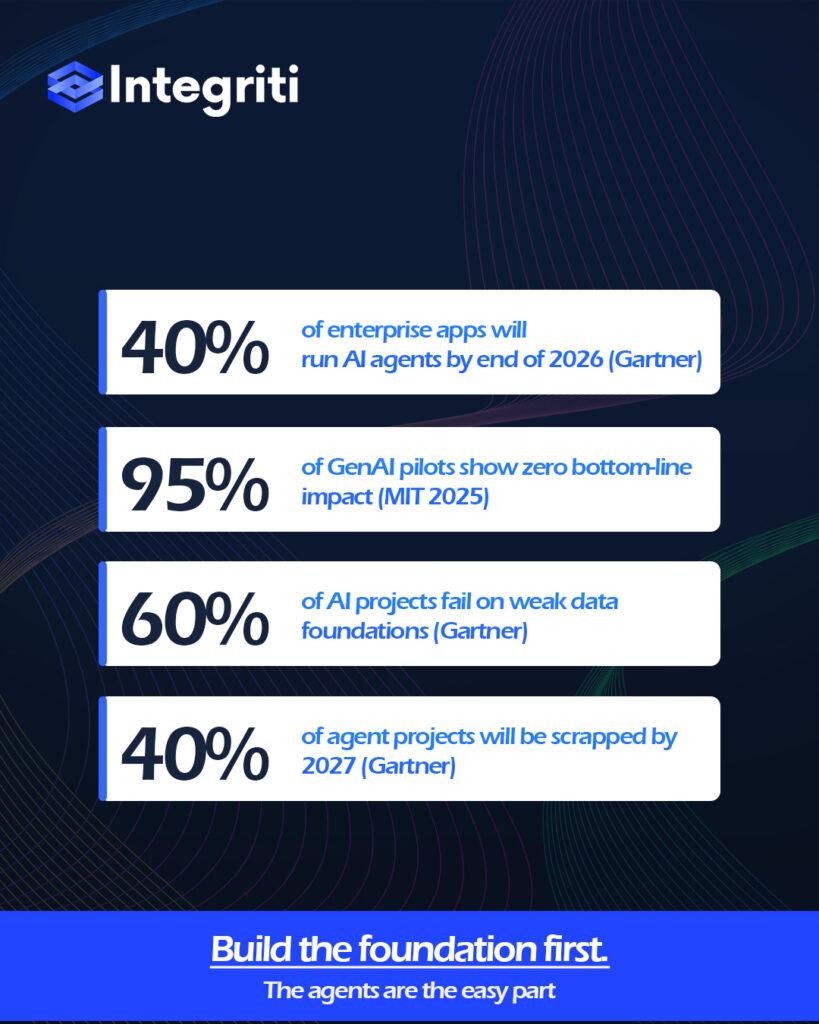
    Gartner expects 40% of enterprise applications to embed task-specific AI agents by the end of 2026, up from less than 5% a year earlier. Yet the same analysts warn that more than 40% of agentic AI projects will be cancelled by the end of 2027, undone by escalating costs, unclear business value, and weak risk controls. Both numbers are true at once. The gap between them is where most organizations will either win or quietly waste their budgets.

    The Uncomfortable Data

    The most sobering signal comes from MIT. Its 2025 State of AI in Business report found that roughly 95% of enterprise generative-AI pilots delivered no measurable impact on the bottom line. The failures, researchers noted, were rarely about the model. They were about brittle workflows, missing feedback loops, and data that was never ready for production.

    That last point is the quiet killer. Gartner predicts 60% of AI projects will be abandoned through 2026 because organizations lack AI-ready data — and 63% of organizations either lack the right data-management practices or are unsure whether they have them. Informatica’s 2025 CDO survey ranked data quality and readiness as the number-one obstacle to AI success.

    The pattern is unmistakable: agents fail not because the intelligence is weak, but because the foundation beneath them is.

    → See how we assess data readiness before any agent goes live 

    Why Agents Amplify Your Weaknesses

    A chatbot that retrieves a wrong answer is an inconvenience. An autonomous agent that acts on bad data — approving an invoice, adjusting inventory, escalating a case — turns that inconvenience into a business consequence. Autonomy raises the stakes of every flaw already living in your environment.

    This is why “foundation before agents” isn’t a slogan it’s a sequence. Before deploying autonomous systems, three things have to be in place:

    • Clean, governed, accessible data. McKinsey’s 2025 research found organizations reporting significant returns from AI were markedly more likely to have redesigned their end-to-end data workflows before choosing models.
    • Clear ownership and guardrails. Gartner’s 2026 Hype Cycle flagged agentic-AI governance, security, and cost discipline as defining concerns emerging early — not afterthoughts.
    • A defined outcome. The winning 5% in MIT’s study consistently started with a measurable business problem, not a flashy demo.

    Start Where the Foundation Is Strongest

    The encouraging news is that adoption intent is real, and disciplined teams are pulling ahead.

    Gartner’s 2026 CIO survey found only 17% of organizations have deployed AI agents so far, but more than 60% expect to within two years the most aggressive adoption curve of any emerging technology measured.

    The organizations in that leading 17% rarely started with the most glamorous use case. They started where their data was cleanest, their workflows best understood, and their success metrics clearest often in the back office, where MIT found returns were highest. They treated agents as accountable systems with defined responsibilities, not as magic layered on top of legacy chaos.

    → Talk to our team about a governed agentic-AI roadmap

    The Takeaway

    Agentic AI will reshape enterprise operations over the next decade — Gartner’s best-case scenario has it driving roughly 30% of enterprise application software revenue, more than $450 billion, by 2035. But that future belongs to the companies that resist the temptation to rush.

    The question worth asking in your next planning session isn’t

    “which agent should we build first?”

    It’s “is our foundation ready to be trusted with autonomy?”

    Get that answer right, and the agents will follow. Get it wrong, and you risk joining the 40% of projects quietly shut down by 2027.

    Build the foundation first. The agents are the easy part.

  • Integriti Group, Inc. receives 2022 Best of Staffing Talent Award

    Mississauga, ON (February 8, 2022)– Integriti Group Inc., leading software development and digital commerce service provider, announced today that they have won the Best of Staffing Talent Award for providing superior service to their candidates. Presented in partnership with presenting sponsor Indeed and gold sponsor Talent.com, ClearlyRated’s Best of Staffing® Award winners have proven to be industry leaders in service quality based entirely on ratings provided by their candidates. On average, job seekers who work with winning agencies are twice as likely to be completely satisfied with the services provided compared to those placed by non-winning agencies. Integriti Group Inc. received satisfaction scores of 9 or 10 out of 10 from 80% of their placed job candidates, significantly higher than the industry’s average of 40%.

    “Finding and retaining quality tech talent has been a struggle in a post-pandemic world. Talent satisfaction has always been a priority for us as it allows us to provide our clients with top-notch augmented and dedicated teams, onsite, remote and through our global delivery team. We are proud to have been recognized by ClearlyRated for our commitment to candidate engagement and experience,” said Kamran Azam, Partner, Integriti Group.

    “Winning this industry-recognized award for a second year is a testament to our team’s dedication to the candidate experience. We work with highly talented software professionals. At each stage of their journey our candidates feel fully valued and appreciated by everyone at Team Integriti.” said Omer Husain, Partner, Integriti Group.

    “Winners of the 2022 Best of Staffing award have demonstrated their commitment to delivering exceptional service, even as Covid-19 has forced them to reimagine and rebuild their approach to business,” said ClearlyRated’s CEO and Founder, Eric Gregg. “These service leaders have kept the client, talent, and employee experience at the heart of their business strategy, and it’s my honor to celebrate and showcase the 2022 Best of Staffing winners alongside feedback from their actual clients on ClearlyRated.com!”

    About Integriti Group Inc.

    Integriti is an award-winning IT services provider based in Mississauga, Canada. It has been selected among the Top Custom Software Development Companies in Canada by Designrush. It blends extensive technological knowledge with real-world experience to provide companies with premium software development and digital commerce services which can bolster their growth.

    About ClearlyRated

    Rooted in satisfaction research for professional service firms, ClearlyRated utilizes a Net Promoter® Score survey program to help professional service firms measure their service experience, build an online reputation, and differentiate on service quality. Learn more at https://www.clearlyrated.com/solutions/.

    About Best of Staffing
    ClearlyRated’s Best of Staffing® Award is the only award in the U.S. and Canada that recognizes staffing agencies that have proven superior service quality based entirely on ratings provided by their clients, placed talent, and internal employees. Award winners are showcased by city and area of expertise on ClearlyRated.com—an online business directory that helps buyers of professional services find service leaders and vet prospective firms with the help of validated client ratings and testimonials.