Category: io-blogs

  • The CIO’s Guide to AI Tokenomics: Controlling Cost at Scale

    The CIO’s Guide to AI Tokenomics: Controlling Cost at Scale


    For the last two years, the question CIOs faced about AI was whether it could work. That question is settled. The models are capable, the use cases are proven, and nearly every enterprise has something in production or close to it.

    As enterprises expand their AI development efforts and push autonomous AI agents into real workflows, the volume of model calls, and the cost behind them, is climbing faster than most budgets anticipated.

    A harder question has taken its place, and it’s the one that will separate the organizations that scale AI from the ones that quietly pull back: what does it actually cost, and what does it return?

    This is AI tokenomics. Every prompt, every query, every model call consumes tokens, and every token has a price. At pilot scale, nobody notices. A few hundred dollars a month is a rounding error. But AI usage doesn’t stay at pilot scale. It spreads across teams, embeds into workflows, and starts running thousands of times a day. Those invisible per-token costs compound into a number large enough to erase the value the AI was supposed to create. Plenty of CIOs are discovering this the hard way, in a cloud bill that arrived without warning.

    Controlling it isn’t about using less AI. It’s about governing the economics of AI the same way you’d govern any other major operating expense. That comes down to five disciplines.


    1. Visibility

    You cannot control what you cannot see. The first failure in AI cost management is that most organizations have no idea what their AI actually costs, broken down by team, by use case, or by workflow. The spend shows up as a single opaque line on a cloud invoice, impossible to question or optimize.

    Real visibility means tracking consumption at the level where decisions get made. Which workflows are the heaviest consumers. Which teams are driving spend. Which use cases cost more than they return. Without this, every other discipline is guesswork. With it, the expensive outliers become obvious, and they are almost always a small number of workflows quietly consuming a disproportionate share.

    2. Accountability

    Once you can see the spend, someone has to own it. In most enterprises, AI costs sit in a shared pool that belongs to no one, which means no one is motivated to control them. Spend that belongs to everyone gets managed by nobody.

    Accountability means assigning AI consumption to the teams and leaders who generate it, the same way you’d assign any budget. When a team sees its own AI spend and owns it, behavior changes. Workflows get optimized. Wasteful patterns get questioned. The goal isn’t to punish usage, it’s to make the cost of AI visible to the people in a position to manage it.


    3. Model Routing

    This is where the largest savings usually hide. The instinct, when AI matters, is to send every task to the most capable and most expensive model available. It works, but it’s the equivalent of hiring your most senior engineer to reset passwords.

    Most tasks don’t need the flagship. A simple classification, a short summary, a routine extraction, these can run on a smaller, cheaper, faster model with no loss in quality. Model routing means matching each workload to the right model by cost and capability, reserving the expensive models for the work that genuinely requires them. Done well, it can cut AI costs substantially without touching output quality. It is the single highest-leverage move in AI tokenomics, and the one most organizations haven’t made.

    This matters even more as autonomous AI agents enter production, since a single agent can chain dozens of model calls to complete one task, multiplying cost in ways a simple prompt never would.

    4. Value Proofing

    Cost is only half the equation. The point of governing tokenomics isn’t to spend as little as possible, it’s to ensure every dollar spent returns more than it consumes. A workflow that costs more to run than the value it produces should be caught and either fixed or retired.

    Value proofing means measuring return, not just spend. For each significant use case, what is it actually saving or generating against what it costs to run? This is how AI earns its place in the budget, and how a CIO defends that budget to the board. It’s also how you avoid the trap of impressive-looking AI that is quietly running at a loss.

    5. Skills Development

    All of this requires people who understand it. Tokenomics is a new discipline, and the teams running your AI need the skills to monitor consumption, route models intelligently, and reason about cost and value together. Without that capability in-house, cost control defaults to hope.

    Investing in these skills is what makes the other four disciplines sustainable. It turns cost management from a one-time cleanup into an ongoing capability that scales with your AI footprint.

    The shift this requires

    The uncomfortable truth is that most enterprises are still treating AI cost as an afterthought, a surprise to be dealt with when the bill arrives, rather than a system to be designed. That worked when AI was a pilot. It breaks the moment AI becomes infrastructure.

    The CIOs who scale AI successfully won’t be the ones who deployed the most or moved the fastest. They’ll be the ones who can account for every dollar their AI spends and every dollar it returns. Capability was the hard part of the last two years. Economics is the hard part of the next two.

    For enterprises investing in AI development services and AI integration across their systems, cost governance isn’t a constraint on ambition. It’s what makes ambition sustainable.

    AI that no one can account for doesn’t get scaled. It gets cut. The difference is whether you built the discipline to govern it before the bill forced the conversation.


  • Build vs Buy in the AI Era: How to Decide Without Regretting It Later

    Build vs Buy in the AI Era: How to Decide Without Regretting It Later

    Every enterprise leadership team eventually walks into a board meeting holding the same slide: should we build our own AI, or buy an existing platform? In 2026, that decision carries more weight than ever. Worldwide AI spending is forecast to reach $2.59 trillion this year, a 47% jump year-over-year, according to Gartner. Yet the return on all that investment remains stubbornly elusive.

    The most cited warning comes from MIT. Its State of AI in Business 2025 report, published by the NANDA initiative, found that roughly 95% of enterprise generative-AI pilots delivered no measurable impact on the bottom line with only about 5% reaching production with real value. (It’s worth noting some analysts have questioned the study’s methodology, so treat the figure as a directional signal rather than gospel.) Crucially, the report concluded the divide wasn’t caused by model quality. It came down to how organizations approached deployment and whether they integrated AI into real workflows or bolted on generic tools.

    That single insight reframes the build-vs-buy question entirely. This is not a technology decision. It is a strategy decision. And getting it wrong is expensive in both directions.

    The Two Ways to Get It Wrong

    Enterprise AI failures cluster around two opposite mistakes.

    Over-buying means adopting generic, off-the-shelf tools that demo beautifully but prove brittle in production. They don’t learn your workflows, don’t respect your data model, and don’t move the metrics that matter. The result is high adoption, low transformation.

    Over-building is the reverse: rebuilding commodity capabilities transcription, generic chatbots, standard document extraction from scratch when a mature vendor product already does it well. The cost is staggering, and not just upfront. Custom AI platforms typically carry annual maintenance of 20–30% of the original build cost, before accounting for the scarce, expensive ML talent required to keep them running.

    A Framework: Buy, Boost, or Build

    MIT Sloan popularized a more useful lens than a simple binary: buy, boost, or build.

    Buy when the capability is commoditized and speed matters. General-purpose copilots, standard OCR, and mature vendor platforms rarely justify a ground-up build. If a competitor could purchase the same tool tomorrow, it is not your competitive moat.

    Build when AI is central to your differentiation when the capability depends on proprietary data no vendor can replicate, or when data sovereignty, regulatory control, and deep workflow integration are non-negotiable.

    Boost the path most enterprises actually land on when a vendor platform gets you 70% of the way, and you add the proprietary layer on top: custom retrieval, workflow logic, evaluation, integrations, and human-in-the-loop controls. Buy the foundation, build the differentiator.

    Five Questions That Decide It

    For any given initiative, the decision comes down to five factors, scored workflow by workflow rather than once for the whole organization:

    1. Capability — do we have the internal talent to build and, more importantly, maintain this?
    2. Complexity — is this a standard use case or genuinely proprietary?
    3. Criticality — how central is this to our competitive position?
    4. Time-to-value — can we afford a six-to-twelve-month build, or do we need results this quarter?
    5. Lock-in risk — does buying route us permanently into one vendor’s ecosystem?

    The most common error is treating build-vs-buy as a single, binary call made once. It isn’t. A mature enterprise will buy commodity layers, boost vendor platforms for edge cases, and build only the handful of capabilities that define its market position.

    The Way Forward

    The organizations pulling ahead in 2026 are not the ones spending the most, nor the ones with the largest in-house AI teams. They are the ones asking the right question for each workflow and then executing with secure architecture, clear ROI metrics, and the discipline to integrate AI into how work actually gets done.

    The regret rarely comes from choosing build or buy. It comes from choosing without a framework.

    Ready to Make the Right Call?

    Explore our AI services: See how Integriti’s AI & Automation Solutions help enterprises architect the right build, buy, or hybrid strategy and integrate AI into workflows that deliver measurable ROI.

    Talk to our team: Facing a build-vs-buy decision right now? Book a free 30-minute consultation and walk away with a clear decision framework for your top-priority use case.

  • Canada’s AI Paradox: What’s Really Stopping Canadian Companies from Adopting AI?

    Canada’s AI Paradox: What’s Really Stopping Canadian Companies from Adopting AI?

    Canada presents one of the most puzzling contradictions in the global technology landscape. The country helped pioneer modern deep learning, hosts world-class research institutes, and maintains one of the deepest AI talent pools anywhere. Yet enterprise AI adoption continues to trail its potential leaving measurable productivity gains on the table for organizations across both Canada and the United States.

    The data illustrates the paradox clearly. According to Statistics Canada’s Q2 2026 Canadian Survey on Business Conditions, 19.2% of Canadian businesses now use AI to produce goods or deliver services triple the rate recorded in 2024.

    That progress puts Canada roughly on par with U.S. adoption rates of 17–20% reported by the U.S. Census Bureau. However, 40% of Canadian businesses still report that AI is simply not relevant to their operations while the Business Development Bank of Canada finds that 97% of SMEs that adopted AI report tangible benefits.

    Article content

    If AI delivers this consistently for adopters, what explains the hesitation? Five structural pain points stand out.

    1.     The AI Skills and Talent Gap

    Research from the Future Skills Centre identifies the top barrier cited by Canadian employers: difficulty sourcing professionals with the expertise to integrate AI into production environments. The irony is stark Canada is home to more than 140,000 AI professionals. The talent exists, but it remains concentrated in research hubs and large technology firms rather than distributed across the mid-market. This structural mismatch explains why staff augmentation and partner-led implementation have become the fastest, lowest-risk paths to enterprise AI adoption.

    2. Cybersecurity, Privacy, and Data Governance

    In the latest Statistics Canada survey, cybersecurity and privacy concerns rank as the leading barrier limiting AI use cited by 30% of businesses with 100 or more employees. The concern is legitimate: large language models and machine learning pipelines introduce new attack surfaces, data residency questions, and compliance obligations. But in practice, this risk is an architecture problem, not an adoption blocker. Secure API design, role-based access controls, encryption in transit and at rest, and governance frameworks embedded from day one convert AI risk into a manageable engineering discipline.

    3. Cost and Total Cost of Ownership

    Cost pressure lands hardest where growth should be happening. Statistics Canada found that cost limits AI use for 15.1% of businesses with 20–99 employees significantly more than for smaller firms. Mid-sized organizations are too complex for off-the-shelf consumer tools but hesitant to fund enterprise-scale transformation. The solution is not a larger budget; it is a phased roadmap that targets high-ROI workflows first intelligent document processing, payroll automation, legacy system integration and scales based on validated returns.

    4. The “Imagination Gap” and the Missing Business Case

    RBC researchers describe an “imagination gap”: leaders who believe in AI’s macro-level importance but cannot map it onto their own operations. The Future Skills Centre reinforces the finding nearly three-quarters of Canadian businesses struggle to identify a business case for AI. The most successful deployments rarely begin with a moonshot. They begin with a single high-friction process manual data entry, reconciliation errors, slow reporting cycles and automate it end-to-end.

    5. The Governance and ROI Gap

    IBM’s 2026 Institute for Business Value study exposes a widening “control gap”: 90% of Canadian CEOs say they are embedding AI across multiple workflows, yet only 43% of AI initiatives delivered their expected ROI over the past two years. Adoption is outpacing oversight. Without architecture-led delivery, MLOps discipline, and measurable KPIs, AI becomes expensive experimentation. With them, it becomes durable digital transformation.

    The Way Forward

    None of these pain points is fundamentally a technology problem. They are strategy, talent, and execution problems and all of them are solvable. The organizations pulling ahead in North America are not those with the largest AI budgets. They are the ones that start with a clearly scoped use case, secure architecture, and access to the right engineering expertise.

    The paradox ends the moment a business stops asking whether AI is relevant — and starts asking where.

    Ready to Move from AI Hesitation to AI Advantage?

    Explore our AI services: Discover how Integriti’s AI & Automation Solutions help enterprises convert complex challenges into measurable growth from intelligent automation to full-scale AI implementation.

    Talk to our team: Have a specific challenge in mind? Book a free 30-minute consultation and walk away with a practical AI adoption roadmap for your organization.

  • Enterprise Agentic AI: Foundation Before Agents

    Enterprise Agentic AI: Foundation Before Agents

    Every boardroom conversation in 2026 seems to circle back to one word: agents. Autonomous systems that don’t just answer questions but plan, decide, and act on their own. The excitement is justified and so is the caution.

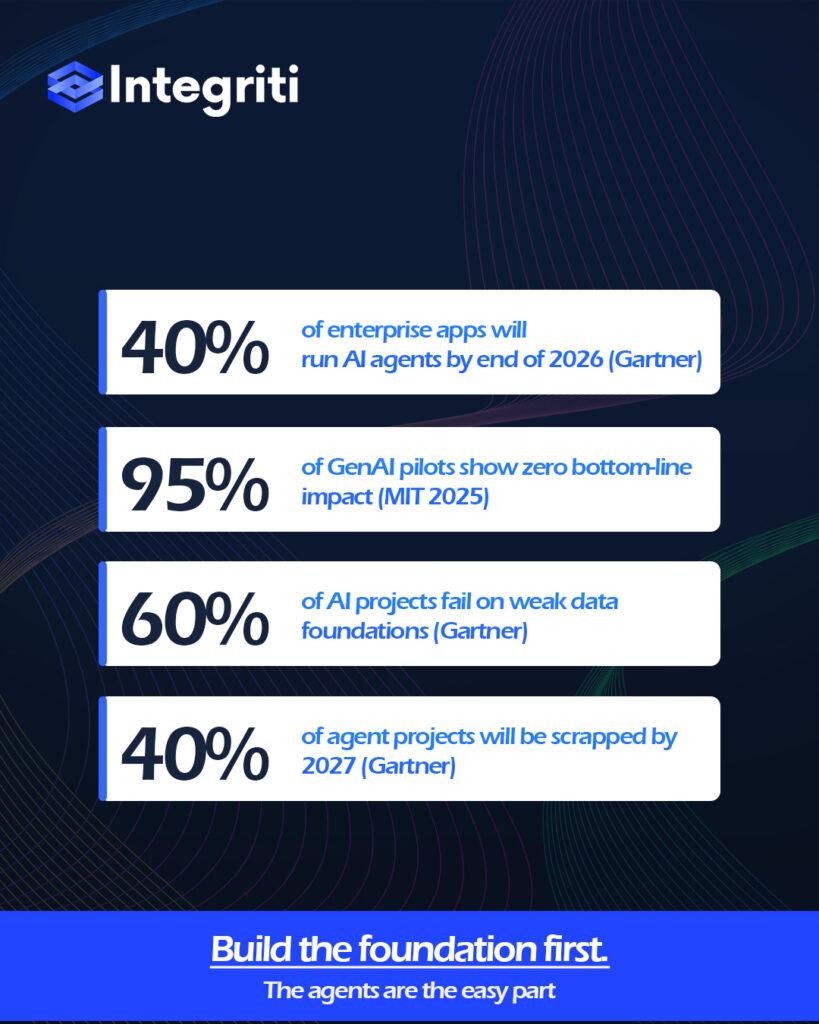
    Gartner expects 40% of enterprise applications to embed task-specific AI agents by the end of 2026, up from less than 5% a year earlier. Yet the same analysts warn that more than 40% of agentic AI projects will be cancelled by the end of 2027, undone by escalating costs, unclear business value, and weak risk controls. Both numbers are true at once. The gap between them is where most organizations will either win or quietly waste their budgets.

    The Uncomfortable Data

    The most sobering signal comes from MIT. Its 2025 State of AI in Business report found that roughly 95% of enterprise generative-AI pilots delivered no measurable impact on the bottom line. The failures, researchers noted, were rarely about the model. They were about brittle workflows, missing feedback loops, and data that was never ready for production.

    That last point is the quiet killer. Gartner predicts 60% of AI projects will be abandoned through 2026 because organizations lack AI-ready data — and 63% of organizations either lack the right data-management practices or are unsure whether they have them. Informatica’s 2025 CDO survey ranked data quality and readiness as the number-one obstacle to AI success.

    The pattern is unmistakable: agents fail not because the intelligence is weak, but because the foundation beneath them is.

    → See how we assess data readiness before any agent goes live 

    Why Agents Amplify Your Weaknesses

    A chatbot that retrieves a wrong answer is an inconvenience. An autonomous agent that acts on bad data — approving an invoice, adjusting inventory, escalating a case — turns that inconvenience into a business consequence. Autonomy raises the stakes of every flaw already living in your environment.

    This is why “foundation before agents” isn’t a slogan it’s a sequence. Before deploying autonomous systems, three things have to be in place:

    • Clean, governed, accessible data. McKinsey’s 2025 research found organizations reporting significant returns from AI were markedly more likely to have redesigned their end-to-end data workflows before choosing models.
    • Clear ownership and guardrails. Gartner’s 2026 Hype Cycle flagged agentic-AI governance, security, and cost discipline as defining concerns emerging early — not afterthoughts.
    • A defined outcome. The winning 5% in MIT’s study consistently started with a measurable business problem, not a flashy demo.

    Start Where the Foundation Is Strongest

    The encouraging news is that adoption intent is real, and disciplined teams are pulling ahead.

    Gartner’s 2026 CIO survey found only 17% of organizations have deployed AI agents so far, but more than 60% expect to within two years the most aggressive adoption curve of any emerging technology measured.

    The organizations in that leading 17% rarely started with the most glamorous use case. They started where their data was cleanest, their workflows best understood, and their success metrics clearest often in the back office, where MIT found returns were highest. They treated agents as accountable systems with defined responsibilities, not as magic layered on top of legacy chaos.

    → Talk to our team about a governed agentic-AI roadmap

    The Takeaway

    Agentic AI will reshape enterprise operations over the next decade — Gartner’s best-case scenario has it driving roughly 30% of enterprise application software revenue, more than $450 billion, by 2035. But that future belongs to the companies that resist the temptation to rush.

    The question worth asking in your next planning session isn’t

    “which agent should we build first?”

    It’s “is our foundation ready to be trusted with autonomy?”

    Get that answer right, and the agents will follow. Get it wrong, and you risk joining the 40% of projects quietly shut down by 2027.

    Build the foundation first. The agents are the easy part.