Canada presents one of the most puzzling contradictions in the global technology landscape. The country helped pioneer modern deep learning, hosts world-class research institutes, and maintains one of the deepest AI talent pools anywhere. Yet enterprise AI adoption continues to trail its potential leaving measurable productivity gains on the table for organizations across both Canada and the United States.
The data illustrates the paradox clearly. According to Statistics Canada’s Q2 2026 Canadian Survey on Business Conditions, 19.2% of Canadian businesses now use AI to produce goods or deliver services triple the rate recorded in 2024.
That progress puts Canada roughly on par with U.S. adoption rates of 17–20% reported by the U.S. Census Bureau. However, 40% of Canadian businesses still report that AI is simply not relevant to their operations while the Business Development Bank of Canada finds that 97% of SMEs that adopted AI report tangible benefits.

If AI delivers this consistently for adopters, what explains the hesitation? Five structural pain points stand out.
1. The AI Skills and Talent Gap
Research from the Future Skills Centre identifies the top barrier cited by Canadian employers: difficulty sourcing professionals with the expertise to integrate AI into production environments. The irony is stark Canada is home to more than 140,000 AI professionals. The talent exists, but it remains concentrated in research hubs and large technology firms rather than distributed across the mid-market. This structural mismatch explains why staff augmentation and partner-led implementation have become the fastest, lowest-risk paths to enterprise AI adoption.
2. Cybersecurity, Privacy, and Data Governance
In the latest Statistics Canada survey, cybersecurity and privacy concerns rank as the leading barrier limiting AI use cited by 30% of businesses with 100 or more employees. The concern is legitimate: large language models and machine learning pipelines introduce new attack surfaces, data residency questions, and compliance obligations. But in practice, this risk is an architecture problem, not an adoption blocker. Secure API design, role-based access controls, encryption in transit and at rest, and governance frameworks embedded from day one convert AI risk into a manageable engineering discipline.
3. Cost and Total Cost of Ownership
Cost pressure lands hardest where growth should be happening. Statistics Canada found that cost limits AI use for 15.1% of businesses with 20–99 employees significantly more than for smaller firms. Mid-sized organizations are too complex for off-the-shelf consumer tools but hesitant to fund enterprise-scale transformation. The solution is not a larger budget; it is a phased roadmap that targets high-ROI workflows first intelligent document processing, payroll automation, legacy system integration and scales based on validated returns.
4. The “Imagination Gap” and the Missing Business Case
RBC researchers describe an “imagination gap”: leaders who believe in AI’s macro-level importance but cannot map it onto their own operations. The Future Skills Centre reinforces the finding nearly three-quarters of Canadian businesses struggle to identify a business case for AI. The most successful deployments rarely begin with a moonshot. They begin with a single high-friction process manual data entry, reconciliation errors, slow reporting cycles and automate it end-to-end.
5. The Governance and ROI Gap
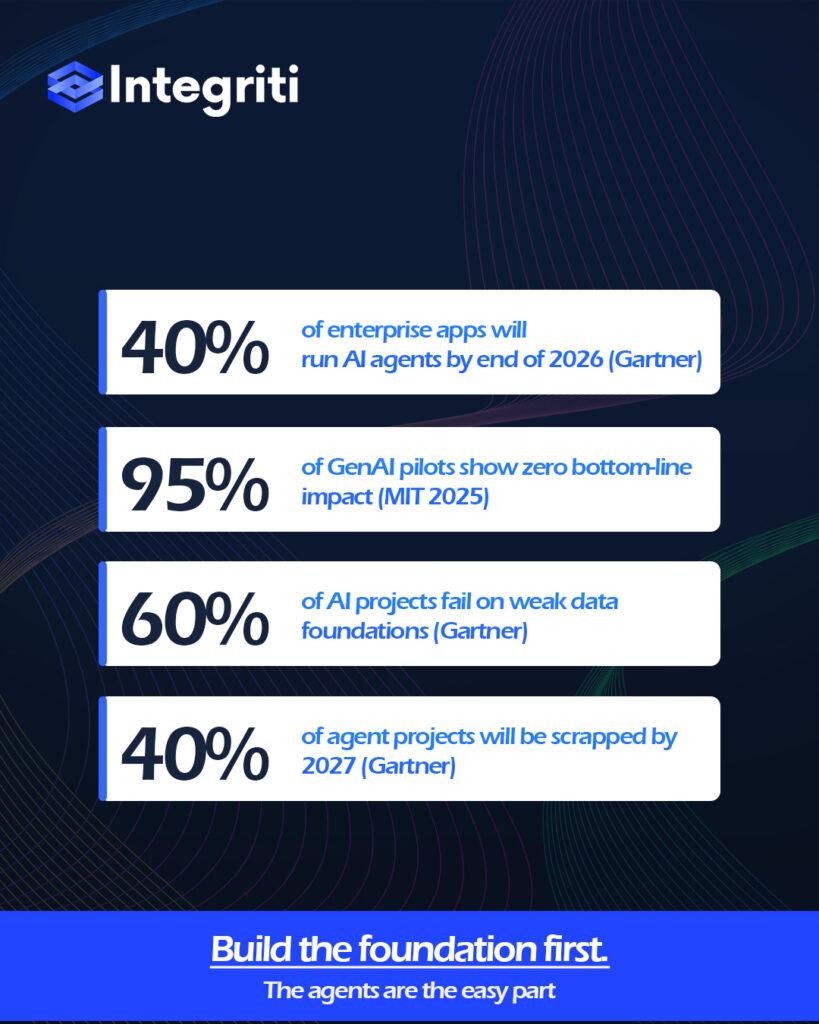
IBM’s 2026 Institute for Business Value study exposes a widening “control gap”: 90% of Canadian CEOs say they are embedding AI across multiple workflows, yet only 43% of AI initiatives delivered their expected ROI over the past two years. Adoption is outpacing oversight. Without architecture-led delivery, MLOps discipline, and measurable KPIs, AI becomes expensive experimentation. With them, it becomes durable digital transformation.
The Way Forward
None of these pain points is fundamentally a technology problem. They are strategy, talent, and execution problems and all of them are solvable. The organizations pulling ahead in North America are not those with the largest AI budgets. They are the ones that start with a clearly scoped use case, secure architecture, and access to the right engineering expertise.
The paradox ends the moment a business stops asking whether AI is relevant — and starts asking where.
Ready to Move from AI Hesitation to AI Advantage?
Explore our AI services: Discover how Integriti’s AI & Automation Solutions help enterprises convert complex challenges into measurable growth from intelligent automation to full-scale AI implementation.
Talk to our team: Have a specific challenge in mind? Book a free 30-minute consultation and walk away with a practical AI adoption roadmap for your organization.